


2026 Peak Season Surcharges: What UPS, FedEx, and USPS Will Actually Charge You
If you ship parcels in the United States, your cost per package is about to go up — not because you negotiated a worse contract, but because the calendar changed. UPS, FedEx and USPS all apply temporary peak-season charges between late September and mid-January, and the 2026 schedules are now published in full.
This guide lays out exactly what each carrier will charge, when each window opens and closes, and how much it realistically adds to a small or mid-sized store’s shipping bill. Every figure below comes from the carriers’ own published rate documents, current as of September 2026.
The short version: UPS package-characteristic surcharges start September 27, 2026. FedEx starts September 28. USPS temporary holiday prices start October 4. All three run into mid-January 2027. The most expensive window for every carrier is roughly Thanksgiving through the day after Christmas.
The three start dates to put on your calendar
Peak surcharges are not one fee. Each carrier splits the season into windows, and the rates step up in the middle window.
| Carrier | Season opens | Peak window (highest rates) | Season closes |
|---|---|---|---|
| UPS | Sept 27, 2026 | Nov 22 – Dec 26, 2026 | Jan 16, 2027 |
| FedEx | Sept 28, 2026 | Nov 23 – Dec 27, 2026 | Jan 17, 2027 |
| USPS | Oct 4, 2026 | Single flat window | Jan 17, 2027 |
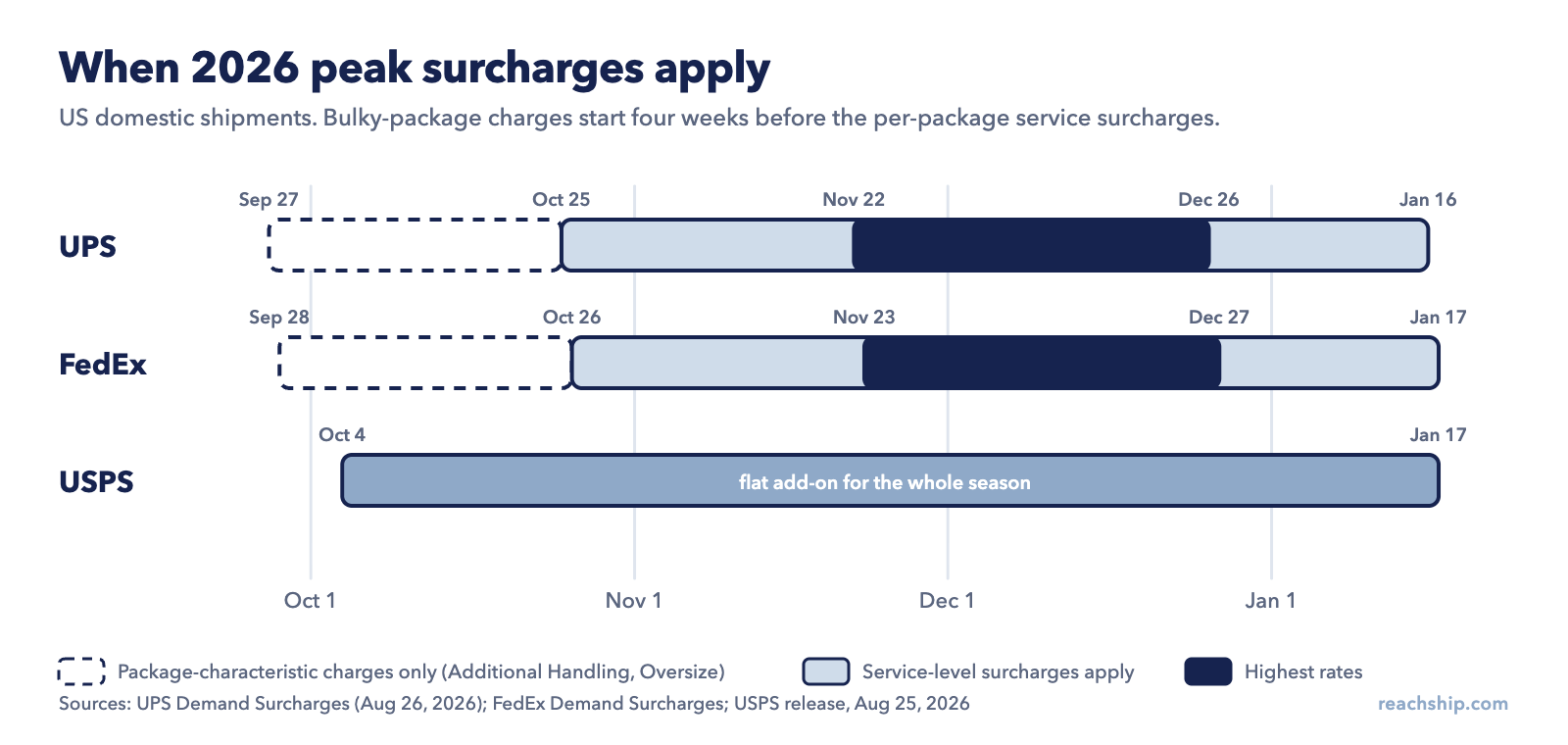
One detail that catches people out: at both UPS and FedEx, the charges tied to package characteristics (oversized, awkward to handle) start in late September, but the charges tied to service level (residential ground, air) don’t begin until late October. If you ship bulky goods, your peak season effectively starts four weeks earlier than everyone else’s.
UPS demand surcharges for 2026
UPS calls these “Demand Surcharges.” They come in two groups.
Charges that apply to every UPS shipper
There is no volume threshold on these. Ship one qualifying package and you pay.
| Charge | Sept 27 – Nov 21 | Nov 22 – Dec 26 | Dec 27 – Jan 16 |
|---|---|---|---|
| Additional Handling | $8.75 | $11.90 | $8.75 |
| Large Package Surcharge | $96.25 | $117.50 | $96.25 |
| Over Maximum Limits | $530.00 | $590.00 | $530.00 |
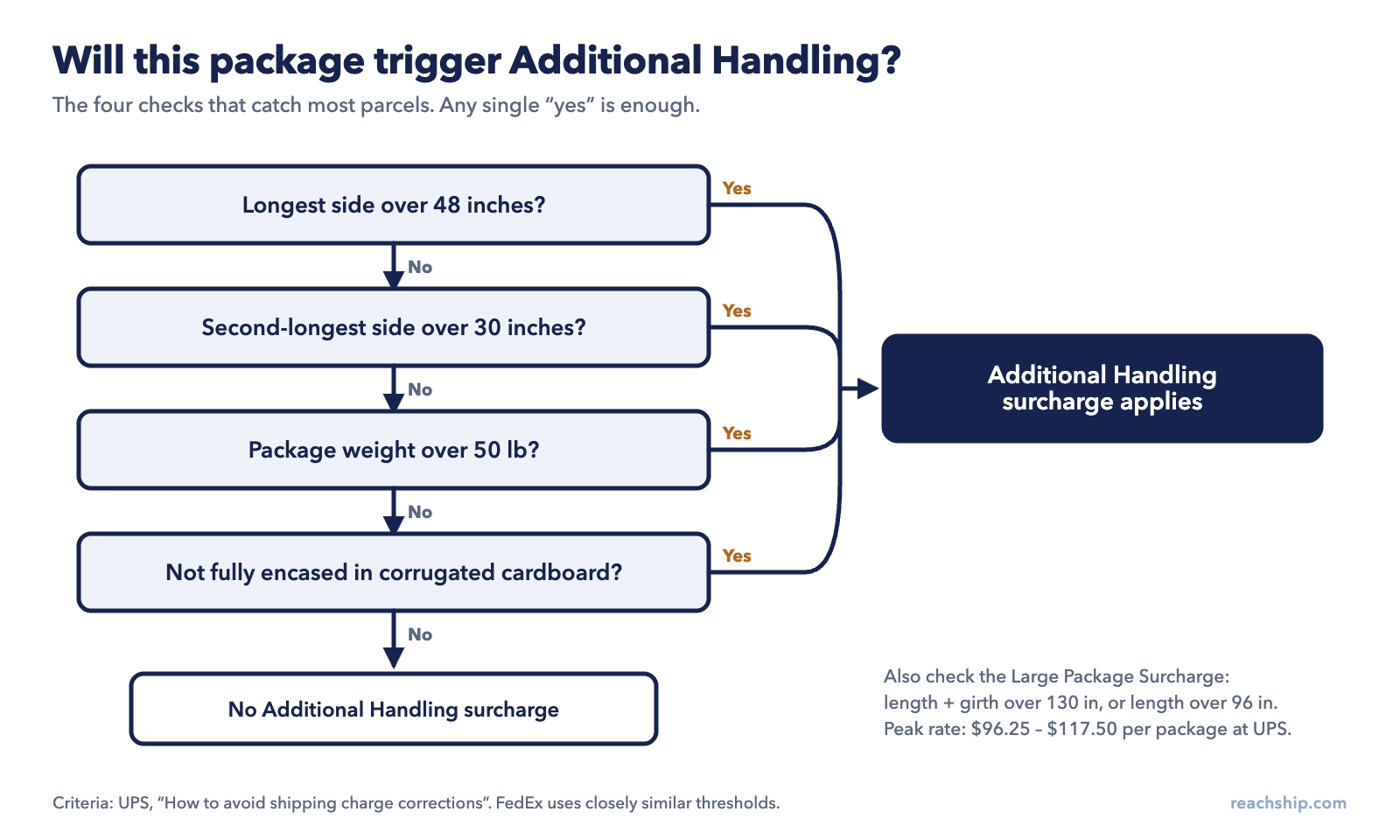
All amounts are per package. Additional Handling applies to packages that are unusually long, not fully encased in corrugated cardboard, or over 50 lbs. Large Package Surcharge applies when length plus girth exceeds 130 inches. These are the numbers that quietly destroy margins on furniture, sporting goods, pet supplies and anything shipped in its original manufacturer box.
Service-level surcharges
These start on October 25, not September 27.
| Service | Oct 25 – Nov 21 | Nov 22 – Dec 26 | Dec 27 – Jan 16 |
|---|---|---|---|
| UPS Ground Saver | $0.50 | $0.75 | $0.50 |
| UPS Ground Residential | $0.50 | $0.75 | $0.50 |
| UPS Next Day Air | $1.35 | $2.50 | $1.35 |
| All other UPS Air | $1.35 | $2.50 | $1.35 |
If you ship more than 20,000 packages in a week
Higher-volume shippers move onto a tiered schedule that replaces the flat rates above. UPS’s own wording is that the tiered tables apply “in lieu of” the standard schedule — so you pay the tiered amount instead of, not on top of, the flat rate.
The tier you land in depends on your peak factor: your weekly volume expressed as a percentage of a baseline, which UPS defines as your average weekly volume for June 2026 (specifically May 31 through June 27, 2026). A store running at 250% of its June baseline in early December pays $3.35 per Ground Residential package instead of $0.75.
At the top of the scale — above 400% of baseline — Ground Residential reaches $8.00 per package. That is not a rounding error on a $12 shipping label.
FedEx demand surcharges for 2026
FedEx’s structure mirrors UPS’s closely, with dates shifted by one day and amounts that land within a few cents.
| Charge | Sept 28 – Nov 22 | Nov 23 – Dec 27 | Dec 28 – Jan 17 |
|---|---|---|---|
| Additional Handling | $8.80 | $11.85 | $8.80 |
| Oversize | $95.75 | $117.25 | $95.75 |
| Unauthorized Charge | $535.00 | $595.00 | $535.00 |
Service-level charges, starting October 26:
| Service | Oct 26 – Nov 22 | Nov 23 – Dec 27 | Dec 28 – Jan 17 |
|---|---|---|---|
| First / Priority / Standard Overnight | $1.30 | $2.55 | $1.30 |
| 2Day A.M., 2Day, Express Saver | $1.20 | $2.35 | $1.20 |
| Ground Residential / Home Delivery Residential | $0.50 | $0.80 | $0.50 |
| Ground Economy | $2.55 | $4.05 | $2.55 |
The structural difference worth understanding
For high-volume shippers, UPS and FedEx look similar on the surface and behave very differently underneath.
UPS’s tiered table replaces the flat surcharge. FedEx’s tiered Demand Residential Delivery Charge is assessed in addition to the flat surcharge and the standard Residential Delivery Charge — and FedEx states that contracted discounts or caps on the Residential Delivery Charge do not apply to it.
Both carriers use the same headline threshold of 20,000 packages in a week and the same June 2026 baseline period. The economics are not the same. If you are near that threshold and negotiating, this is the clause to read closely.
USPS temporary holiday prices for 2026
USPS does not use the word “surcharge.” It files a temporary price change with the Postal Regulatory Commission, and the higher prices simply become the prices for the season.
The 2026 window runs from 12 a.m. CT on October 4, 2026 to 12 a.m. CT on January 17, 2027, and affects Priority Mail Express, Priority Mail, USPS Ground Advantage and Parcel Select. Nothing else changes.
Unlike UPS and FedEx, USPS expresses the increase as flat dollar add-ons by weight band and zone. A selection of the commercial rates:
| Service | Zones | 0–3 lbs | 4–10 lbs | 11–25 lbs | 26–70 lbs |
|---|---|---|---|---|---|
| Priority Mail & Ground Advantage | 1–4 | $0.40 | $0.65 | $1.05 | $3.15 |
| Priority Mail | 5–9 | $0.85 | $1.75 | $3.85 | $9.10 |
| USPS Ground Advantage | 5–9 | $0.55 | $1.05 | $1.75 | $7.70 |
| Priority Mail Express | 5–9 | $2.35 | $5.55 | $10.50 | $18.20 |
| Parcel Select | All | $0.40 | $0.50 | $0.80 | $2.35 |
Retail prices increase by more than commercial in most bands, and never by less — a lightweight Priority Mail parcel to Zone 5 rises $1.00 at retail versus $0.85 at commercial rates. If you are still buying postage at the counter, peak season is the most expensive time of year to keep doing it.
Two things worth noting. First, these add-ons stack on top of the regular price increase that took effect January 18, 2026, when Ground Advantage rose roughly 7.8% and Priority Mail roughly 6.6%. Second, the shape of the USPS increase is different from the parcel carriers’: it scales steeply with weight and zone, so a heavy long-zone parcel absorbs far more of the increase than a light local one.
What this actually costs: a worked example
Consider a store that ships 500 orders in a normal month and 1,200 in December. The mix is 60% USPS Ground Advantage (commercial, Zones 1–4, under 3 lbs), 30% UPS Ground Residential, and 10% FedEx Home Delivery Residential.
For December, in the most expensive window:
| Channel | Packages | Surcharge each | Total |
|---|---|---|---|
| USPS Ground Advantage | 720 | $0.40 | $288.00 |
| UPS Ground Residential | 360 | $0.75 | $270.00 |
| FedEx Home Delivery | 120 | $0.80 | $96.00 |
| Subtotal | 1,200 | $654.00 |
That is about 55 cents per package — irritating, but survivable.
Now assume just 3% of those parcels trigger Additional Handling, because they ship in a manufacturer’s box that isn’t fully corrugated. That’s 36 packages at roughly $11.90:
$428.40 in additional handling fees alone — nearly two-thirds as much as the entire per-package surcharge bill, from 3% of the volume.
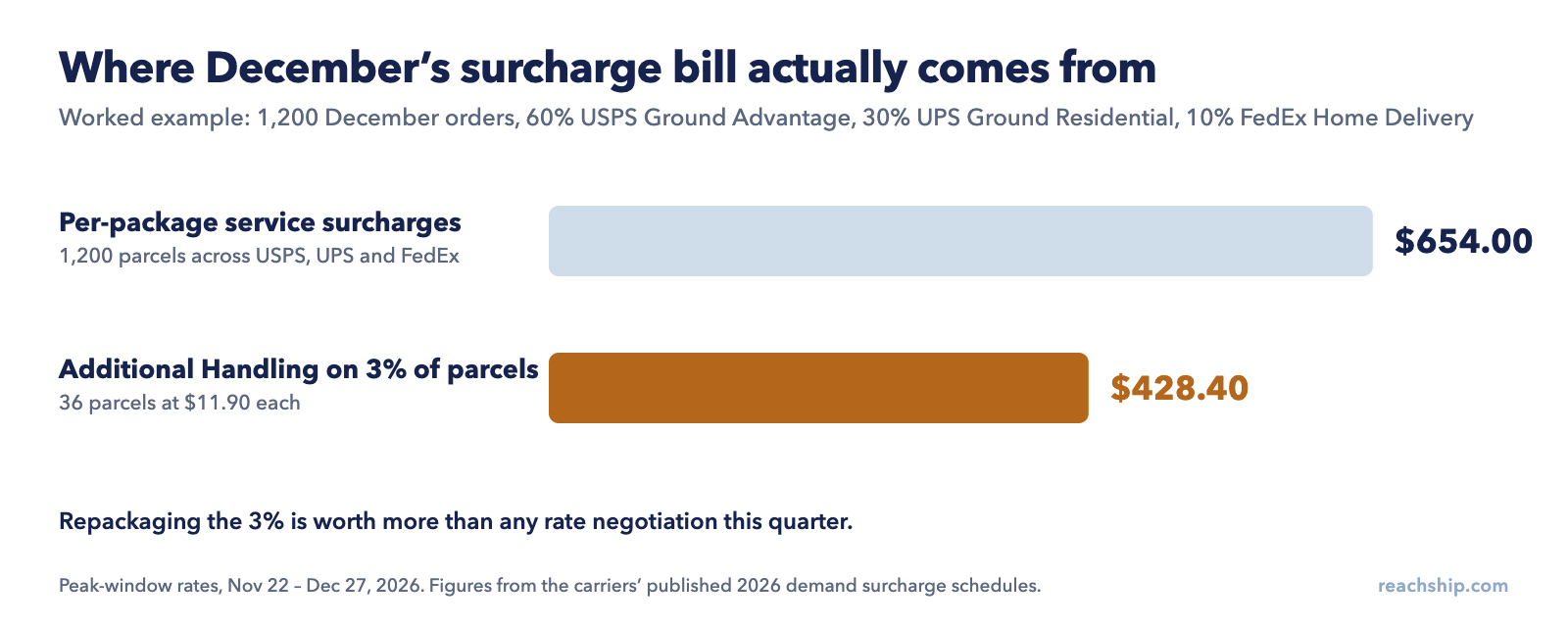
This is the single most useful thing to take away. For most small and mid-sized merchants, the package-characteristic surcharges cost far more than the per-package service surcharges, and they are the ones you can actually do something about.
Five things to do before September 27
- Audit your top 50 SKUs for Additional Handling and Oversize triggers. Measure length plus girth, check whether the outer box is fully corrugated, and confirm weights. Repackaging one bulky bestseller can save more than any rate negotiation this quarter.
- Reprice shipping in your checkout. If you charge flat-rate shipping, your margin absorbs 100% of these surcharges. Model the peak window before you set holiday shipping promotions, not after.
- Compare carriers per order, not per contract. The cheapest carrier for a 2 lb Zone 3 parcel in October may not be cheapest in December, because the surcharges move at different rates on different services.
- Check your dimensional data. Surcharges are assessed on the carrier’s measurement, not yours. Missing or stale dimensions in your product catalogue produce billing adjustments in January that nobody budgeted for.
- Diarise January. Rates fall back on January 16–17, 2027. Any peak-priced service you don’t need in the first half of January is worth deferring a week.
Where rate comparison changes the math
None of the surcharges above are negotiable for most merchants. What is controllable is which label you buy for which order.
When three carriers raise different services by different amounts on different dates, the cheapest option for a given parcel genuinely changes week to week. A store shipping a single carrier’s service all season will overpay on a predictable share of its orders — usually the heavy ones and the long-zone ones.
This is where multi-carrier shipping software does real work: it requests live rates from every carrier you have an account with at the moment the label is created, surcharges included, and shows you the actual cost side by side. ReachShip supports USPS, UPS, FedEx, DHL Express and others from one place, using your own negotiated accounts.
If you want the deeper carrier-by-carrier breakdown, our comparison of USPS versus UPS for ecommerce merchants covers how the two price the same parcel differently, and our guide to preventing shipping delays covers the operational side of peak season.
Shipping across more than one carrier this season?
ReachShip lets you compare live rates from USPS, UPS, FedEx, DHL and regional carriers on every order, print labels in bulk, and track shipments from a single dashboard — on WooCommerce, Shopify, Wix and Magento 2. You can try it with your own carrier accounts before peak volume arrives.
Frequently asked questions
Do peak surcharges apply to my negotiated rates?
Yes. Demand surcharges are applied on top of your contracted base rates unless your agreement explicitly caps or waives them. Contract caps on standard accessorials do not automatically extend to peak surcharges — FedEx says so directly for its tiered residential charge.
Are the surcharges the same for domestic and international shipments?
No. The figures above are for U.S. domestic shipments. UPS and FedEx publish separate international demand surcharge schedules, and USPS’s temporary price change covers domestic services only. Check the international tables separately if you ship cross-border.
Does USPS charge an Additional Handling equivalent?
Not as a peak surcharge. USPS has its own nonmachinable and dimensional pricing rules that apply year-round. The October–January change is purely a price increase on the four affected services, which is why oversized parcels often shift toward USPS during peak.
What happens if my volume crosses 20,000 packages in one week?
You move onto the tiered schedule at that carrier. At UPS the tiered rate replaces the flat rate; at FedEx the tiered residential charge is added to it. Both use your June 2026 weekly average as the baseline for calculating your peak factor, so the comparison is against your own normal volume, not an industry figure.
When do rates return to normal?
UPS surcharges end January 16, 2027. FedEx ends January 17, 2027. USPS temporary prices end at 12 a.m. CT on January 17, 2027. Carriers have revised mid-season schedules in past years, so it is worth re-checking the published documents in November.
Sources

No Comments