


CBP’s Low-Value Shipment Proposal: Entry Filing Moves Before Arrival
For years, the paperwork on a low-value parcel could follow the parcel. You shipped, it landed, and someone had fifteen days to file the entry. U.S. Customs and Border Protection has now proposed reversing that order.
The proposed rule, published on 8 October 2026, would require informal entries to be filed electronically on or before the date the goods arrive. It would also put a bond behind every one of them, pull a licensed customs broker into shipments where the consignee is a carrier or a forwarder, and create a new entry type for international mail with a fifteen-day abandonment clock attached.
None of it is law yet. Comments close on 7 December 2026, which gives you about eight weeks to work out what it would cost you and, if it matters, to say so on the record.
Quick answer: CBP has proposed that informal entries for goods valued at $2,500 or less be filed electronically before arrival rather than within fifteen days after it, backed by a bond, with a new electronic entry type for international mail. CBP estimates the paperwork alone at $39.72 per mail entry. It is a proposed rule, not a final one — comments close 7 December 2026, and CBP has not published an effective date. If you import per-parcel rather than in bulk, this is the change to model now.
What CBP actually published
The document is a notice of proposed rulemaking titled simply Low-Value Shipments, at 91 FR 64532. It would amend parts 113, 128, 141, 143 and 145 of Title 19 of the Code of Federal Regulations.
| Document | Low-Value Shipments, proposed rule |
| Citation | 91 FR 64532 |
| Published | 8 October 2026 |
| Comments close | 7 December 2026 |
| Docket | USCBP-2026-0298 (RIN 1685-AA38) |
| Effective date | Not stated |
The background section explains why CBP is doing this now. Duty-free de minimis treatment has been suspended since August 2025 and was indefinitely suspended for mail by an interim final rule effective 24 July 2026. The statutory exemption itself ends on 1 July 2027. Everything that used to clear as de minimis has to clear as something, and for goods valued at $2,500 or less that something is an informal entry.
We covered what the end of the $800 threshold meant for sellers when it happened, in the $800 de minimis exemption is gone. This proposal is the plumbing being built underneath that decision.
The change that matters most: filing moves ahead of the parcel
Today an entry type 11 informal entry is due within fifteen days after the merchandise lands. Under the proposal it would have to be filed electronically on or before the date of importation.
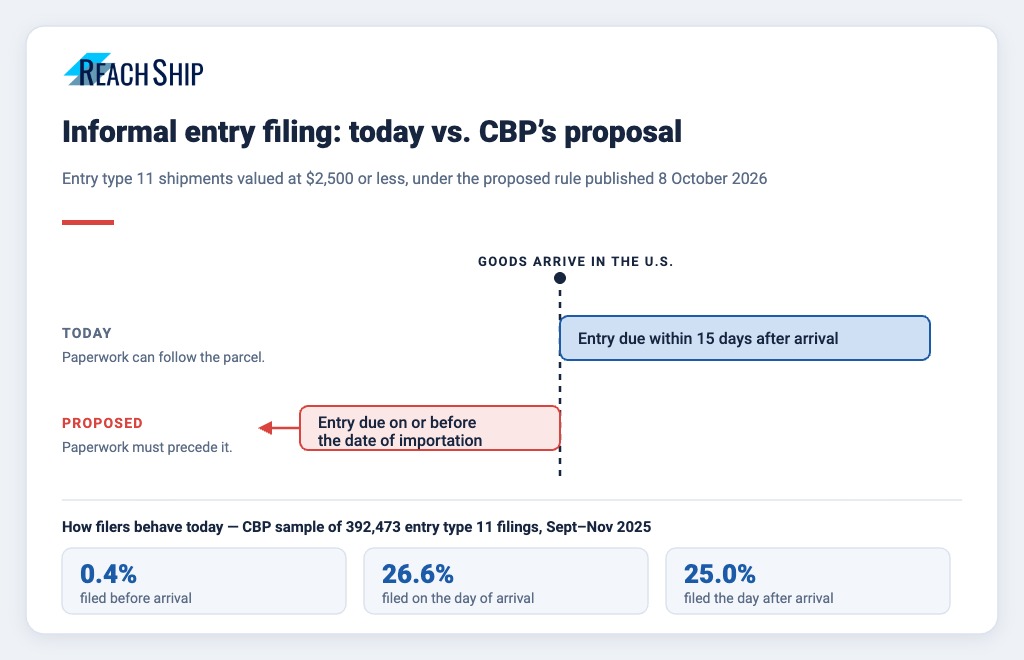
CBP looked at how filers behave now. In a sample of 392,473 entry type 11 filings between September and November 2025, 0.4% were filed before arrival, 26.6% on the day of arrival and 25.0% the day after. CBP reads that as roughly half the population needing only a day or two of extra lead time.
The other half is the problem, and the real cost is not the calendar. It is data quality. When the entry follows the parcel, a wrong classification gets fixed in transit. When the entry precedes it, every detail has to be right at the moment of dispatch, in a warehouse that may be twelve time zones from whoever owns the answer. CBP acknowledges that earlier filing could require overseas staffing, and does not attempt to quantify it.
Four other changes worth reading closely
A broker becomes mandatory for non-owner consignees
Where the consignee is not the owner or purchaser — a foreign postal operator, USPS, a freight forwarder or a carrier — that party would have to appoint a licensed customs broker to act as importer of record. The existing exemptions at 19 CFR 143.26(b) would stay. If your shipments move with the carrier named as consignee, find out now whose licence is going on the entry.
Every informal entry would need a bond
CBP proposes requiring a basic importation and entry bond, single-transaction or continuous, for all entry type 11 and entry type 13 filings. Shipments valued at $2,500 or less would not be released without one. The proposal also sets a floor on liquidated damages for breaching listed bond conditions: the value of the merchandise or $1,000, whichever is greater, and three times the value or $1,000 for restricted, prohibited or alcoholic-beverage goods.
A new mail entry type, and a fifteen-day abandonment clock
Entry type 13 would replace the current postal informal entry process for mail valued at $2,500 or less. It would require the shipper or sender’s identity and address plus the UPU S-10 tracking number, with carriers reporting that tracking number on the inward manifest. CBP began a simplified test of the process on 22 September 2026.
The teeth are in proposed 19 CFR 145.6. A mail shipment still not properly entered fifteen days after importation would not be released and would be deemed voluntarily abandoned, with USPS handling disposition — which can mean destruction or return to sender. That is not a late fee. That is the parcel gone.
One easing: the $250 Chapter 99 cap goes
The $250 limit on goods classified under Chapter 99, Subchapters III and IV of the HTSUS would be removed, so goods valued between $251 and $2,500 that are subject to Section 232 duties could use informal entry rather than being forced into a formal one. CBP also proposes broader discretion to require formal entry on a blanket basis — by importer, by manufacturer or by category of merchandise.
What CBP thinks one entry costs
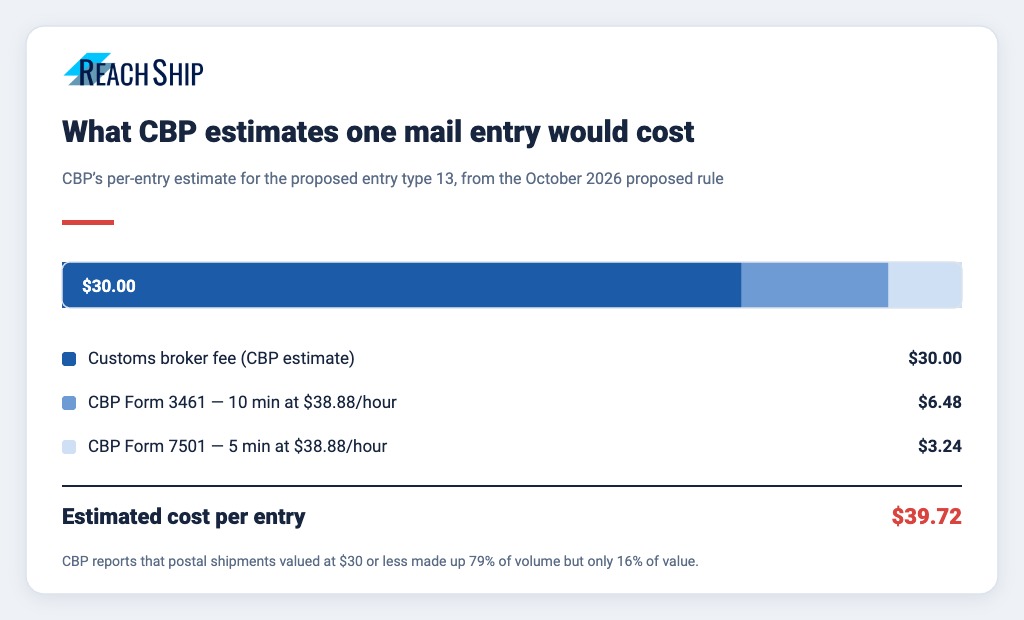
CBP puts the per-entry cost of an entry type 13 filing at $39.72: a $30.00 customs broker fee, $6.48 for CBP Form 3461 (ten minutes at an average hourly wage of $38.88) and $3.24 for Form 7501 (five minutes). The $30 figure is CBP’s estimate of an express carrier brokerage fee, drawn from published research rather than from a tariff, so treat it as a ceiling for a merchant with no filing relationship rather than a quote. CBP offers no estimate at all for the programming work filers would need to do.
A worked example
Assume a brand shipping direct to U.S. consumers from a fulfilment centre in Asia: 2,000 parcels a month, average order value $48, average duty rate 10%, every parcel entered individually.
| Line | Per parcel | Per month |
|---|---|---|
| Duty at 10% of $48 | $4.80 | $9,600 |
| Entry cost (CBP estimate) | $39.72 | $79,440 |
| Added landed cost | $44.52 | $89,040 |
The duty is the small number. The administration is eight times larger, and it does not scale down with order value — a $20 order and a $200 order carry the same entry.
That is the whole strategic point. Per-parcel importing multiplies a fixed cost by your order count. Importing in bulk and fulfilling domestically pays that fixed cost once, on one entry, and then your parcels are ordinary domestic parcels. What you trade for it is warehousing and the cash tied up in inventory sitting in a U.S. location — numbers only your own P&L can settle. But if you have been putting that calculation off, the proposal moves the break-even sharply in one direction.
Which lane are you in?
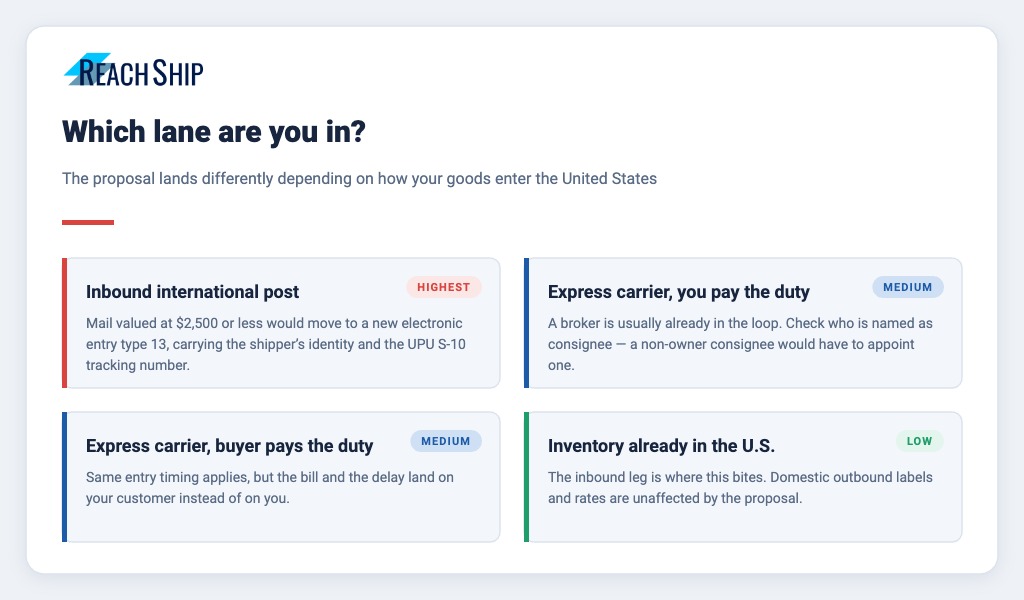
Work through it in this order. How do the goods physically enter the United States — international post, express carrier, or bulk freight you already enter formally? Who is named as consignee? Who pays the duty, you or your customer? Those three answers put you in a lane, and the lane sets how much of this proposal you need to care about.
If the answer to the first question is “bulk freight, already entered formally,” most of this is noise for you. Your exposure sits on the domestic leg instead, where the risks are the familiar ones — address quality, service selection and the causes of shipping delays that peak season amplifies.
Six mistakes to avoid
- Treating it as settled law. It is a proposal. The comment period runs to 7 December 2026 and CBP has published no effective date.
- Assuming your carrier has it covered. Ask explicitly who would be importer of record and whose broker licence is on the entry. “The carrier handles customs” is not an answer.
- Reading the fifteen-day mail clock as a grace period. It ends in deemed abandonment, not a penalty you can pay off.
- Budgeting duty and forgetting the entry. In the example above the administration was eight times the duty.
- Leaving product data to the warehouse. Advance filing turns a sloppy HS code from a mid-transit correction into a shipment that cannot leave.
- Waiting for July 2027. The statutory de minimis end date is a deadline for CBP, not a start date for you.
What to do before 7 December
- Pull last quarter’s inbound shipments and sort them by entry channel. You cannot price the change until you know how much of your volume is mail.
- Confirm who is named as consignee, and get a written answer from your carrier or forwarder on who would file.
- Price a continuous bond against single-transaction bonds at your volume. A broker can quote both in an afternoon.
- Audit your HS codes and shipper data at source, not at the border.
- Run the bulk-import versus per-parcel-import comparison with your real numbers.
- If the proposal would hurt, file a comment on docket USCBP-2026-0298. Agencies read specifics about operational impact far more usefully than objections.
Step five is where a shipping platform earns its place. ReachShip does not file customs entries and does not calculate duties or landed cost — that is broker territory. What it does do is show live rates from your own carrier accounts side by side across WooCommerce, Shopify, Wix and Magento 2, so that when you model holding inventory in the U.S., the domestic leg is a quoted number rather than a guess. If you stay cross-border on an express account instead, the same applies to a DHL Express rate sitting next to a FedEx or UPS one.
If you want to put numbers against the domestic leg before you commit to anything, the ReachShip shipping calculator will quote it on your own accounts.
Frequently asked questions
Is this rule in effect now?
No. It is a proposed rule published on 8 October 2026. Comments close 7 December 2026, and CBP has not stated when a final rule would take effect, though its cost tables assume costs beginning in 2027.
What counts as a low-value shipment here?
Merchandise valued at $2,500 or less, which is the informal entry threshold. This is a different number from the $800 de minimis threshold that has been suspended, and the two are easy to confuse.
Does it change anything for gifts?
The proposal does not change entry procedures for bona fide gifts. CBP’s existing position is that genuine gifts valued at $100 or less are exempt from duty, rising to $200 if sent from someone in the U.S. Virgin Islands, Guam or American Samoa.
What happens if a mail parcel is not entered in time?
Under proposed 19 CFR 145.6, a mail shipment valued at $2,500 or less that is still not properly entered fifteen days after importation would not be released and would be deemed voluntarily abandoned. USPS would then handle disposition.
Would I need a bond for every single parcel?
The proposal would require a basic importation and entry bond for every entry type 11 and entry type 13 filing, but that can be a continuous bond covering all your entries rather than a single-transaction bond per shipment. Which is cheaper depends on your volume, and a broker can quote both.
Does ReachShip handle customs entries or duties?
No. ReachShip covers multi-carrier rate comparison, label printing, pickup scheduling, tracking and order management on your own carrier accounts. Customs entry filing, bonds and landed-cost calculation sit with your broker or your carrier’s brokerage arm.
The short version
CBP is proposing to move low-value entry filing from after arrival to before it, bond it, and bring international mail into line with every other mode. The per-parcel administration it implies is large relative to the parcels themselves, and it does not shrink as your order values do. The useful next step is not to wait for the final rule — it is to find out this month how much of your inbound volume travels by mail, and what one entry would actually cost you.
Sources
- U.S. Customs and Border Protection, Low-Value Shipments, proposed rule, 91 FR 64532, 8 October 2026 (docket USCBP-2026-0298).
- U.S. Customs and Border Protection, Indefinite Suspension of the De Minimis Exemption for Mail Shipments and New Postal Informal Entry Process, interim final rule, 91 FR 37801, 24 June 2026.
- U.S. Customs and Border Protection, CBP modernizes low-value shipment processing, national media release, 24 June 2026.

No Comments