


The $800 De Minimis Exemption Is Gone: What Cross-Border Ecommerce Sellers Must Do Now
For two decades, the simplest way to sell into the United States was to ship small parcels. Anything valued at $800 or less entered duty-free under the de minimis exemption, with minimal paperwork and no broker. That lane is closed.
As of 2026, there is no duty-free threshold for commercial imports into the US at any value, through any mode of transport — including international mail. The change did not happen all at once, and the details differ depending on whether your parcels arrive by post or by express carrier. This article sets out what applies now, what the operational requirements actually are, and what a cross-border seller needs to have in place.
The short version: De minimis is suspended indefinitely for all modes of transport. Non-postal shipments require formal or informal entry. Postal shipments go through a new postal informal entry process, live since July 24, 2026, that requires a customs bond, 10-digit HTS codes and monthly duty payment. A further compliance deadline falls on October 22, 2026, and statutory repeal takes effect July 1, 2027.
How the exemption was dismantled
The de minimis exemption sat in 19 U.S.C. § 1321(a)(2)(C). It was removed in stages, through a mix of legislation, executive action and regulation.
| Date | Instrument | Effect |
|---|---|---|
| July 4, 2025 | One Big Beautiful Bill Act, § 70531 | Repeals commercial de minimis by statute, effective July 1, 2027. Adds civil penalties for misuse — $5,000 for a first violation, $10,000 for each subsequent one |
| Aug 29, 2025 | Executive Order 14324 | Suspends duty-free de minimis globally, “regardless of value, country of origin, mode of transportation, or method of entry” |
| Feb 20, 2026 | Executive Order 14388 | Continues the suspension following a Supreme Court ruling on separate tariff authority |
| June 24, 2026 | CBP interim final rule (FR 2026-12670) | Indefinitely suspends de minimis for all modes other than the international postal network, under 19 U.S.C. § 1321(b) |
| June 24, 2026 | CBP interim final rule (FR 2026-12669) | Suspends de minimis for mail, and creates a new postal informal entry process |
| Aug 13, 2026 | US Court of International Trade | Upholds the suspension, distinguishing de minimis as a “privilege” rather than a tariff |
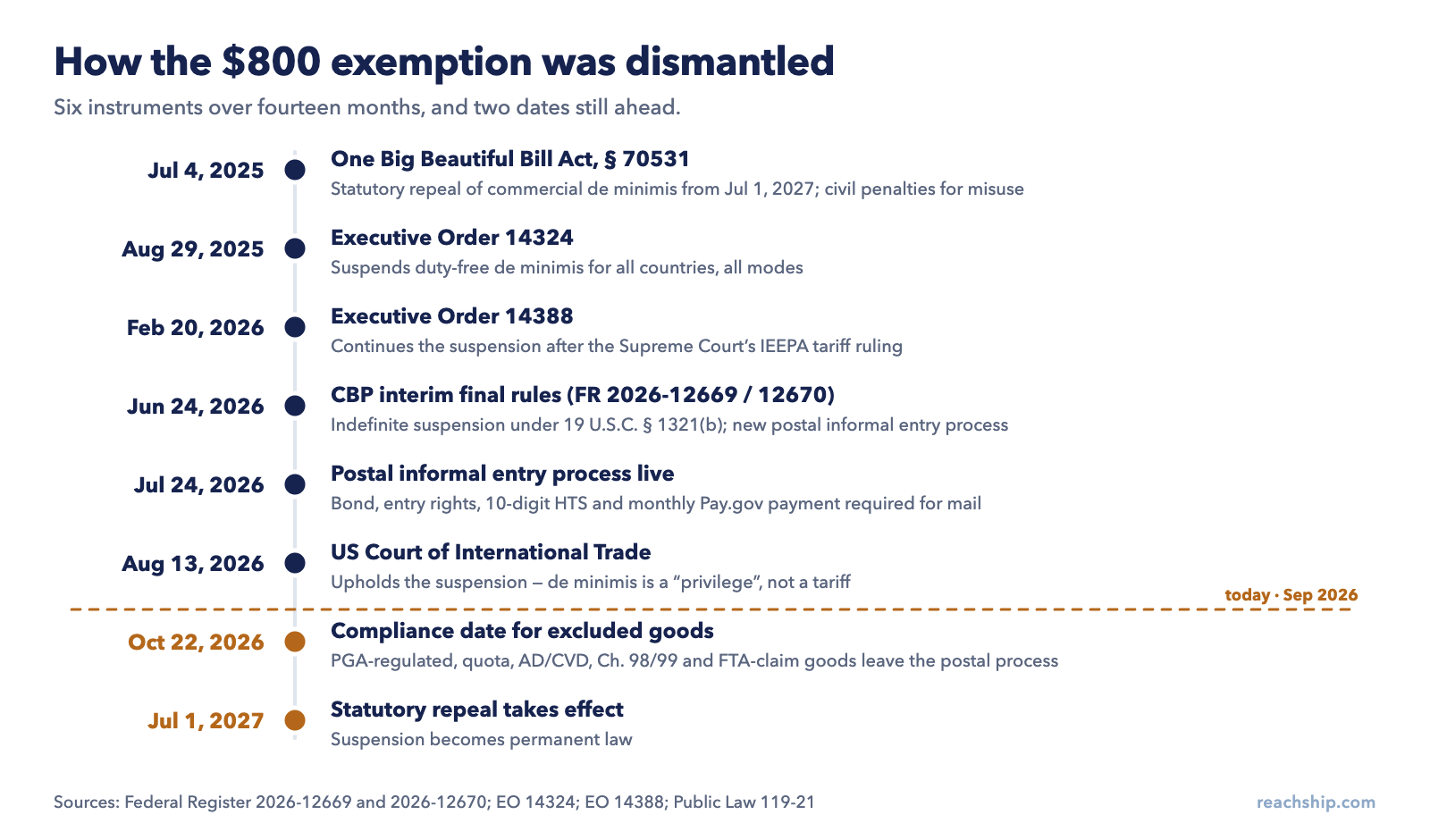
The important structural point: the June 2026 rules rest on 19 U.S.C. § 1321(b), a standing statutory authority that lets CBP make exceptions to protect revenue and prevent unlawful importation. That is a different and more durable footing than the emergency tariff powers that were litigated earlier in 2026. Sellers waiting for the exemption to come back should plan on the basis that it will not.
CBP’s stated rationale gives a sense of the scale involved: de minimis shipments grew from about 139 million a year in 2015 to roughly 1.36 billion in fiscal 2024.
What applies now, by channel
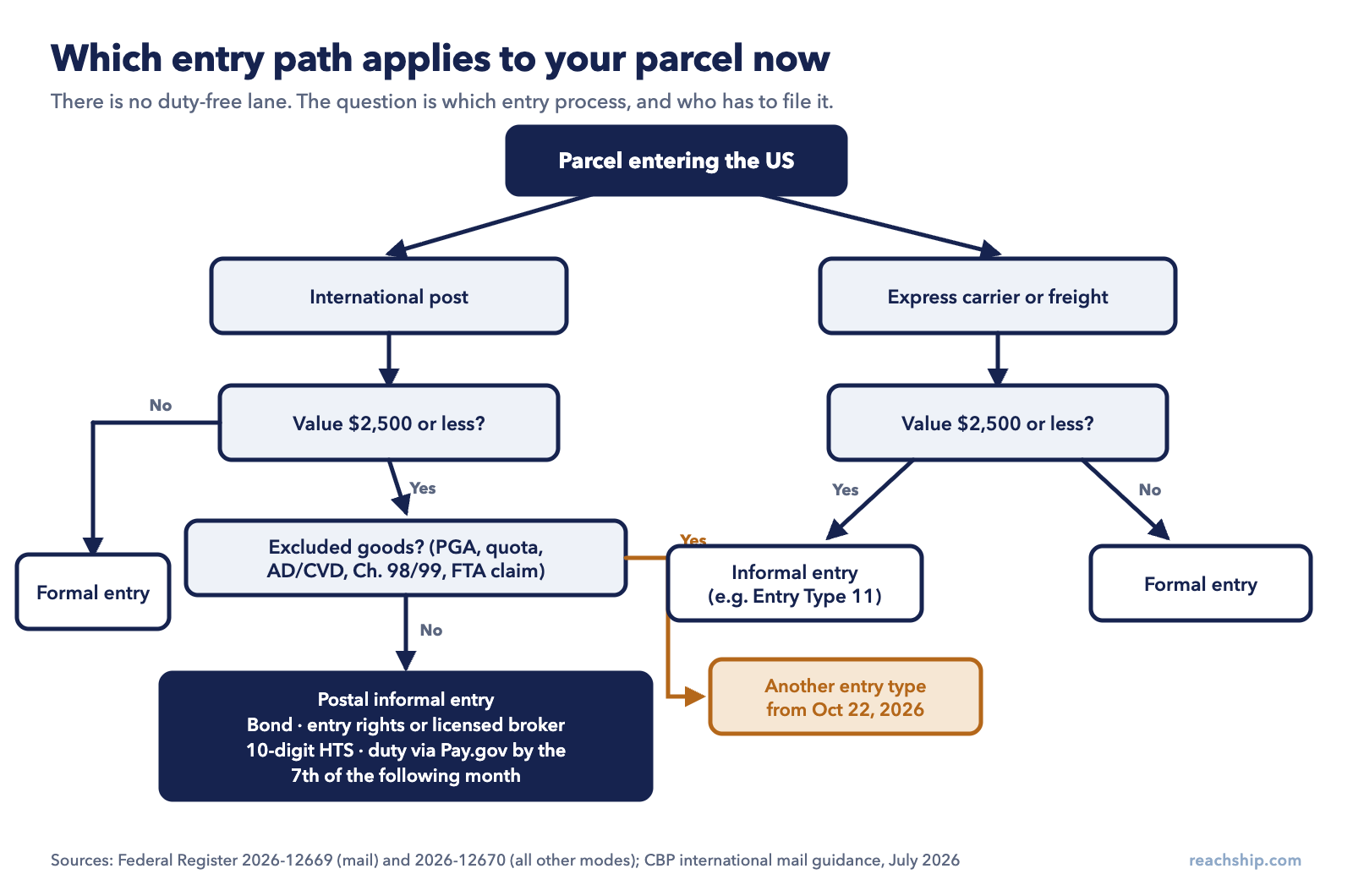
Non-postal: express carriers, air, ocean and truck freight
There is no low-value exemption. Every shipment requires an appropriate entry — formal, or informal where the value is $2,500 or less (commonly Entry Type 11). That means full HTSUS classification and duty payment on every parcel, including a $20 phone case.
Practically, most express carriers handle this as part of their service and bill it back to you, which is why brokerage and disbursement fees on small international parcels have become a visible line item rather than a rounding error.
Postal: international mail
This is where the operational change is sharpest, because the postal channel used to be the one that required almost nothing from the seller.
Since July 24, 2026, mail shipments valued at $2,500 or less can enter through a new postal informal entry process. The requirements are specific:
- Who can file: only a party with entry rights — the owner or purchaser of the goods, or a properly designated licensed customs broker.
- Bond: a basic importation and entry bond is required, single-transaction or continuous.
- Data per shipment: filer code, bond number, description of merchandise, country of origin, all applicable 10-digit HTSUS classifications, quantity or weight where a specific duty rate applies, duty rate, value, total duty owed, carrier, conveyance number, foreign post tracking number, port of arrival and arrival date.
- How duty is paid: the filing is submitted as a spreadsheet to CBP, with duty paid through Pay.gov no later than the 7th day of the month following arrival. A shipment arriving on April 15 must be filed and paid by May 7.
- What CBP no longer does: it no longer prepares entry forms for mail, and no longer collects duty at delivery.
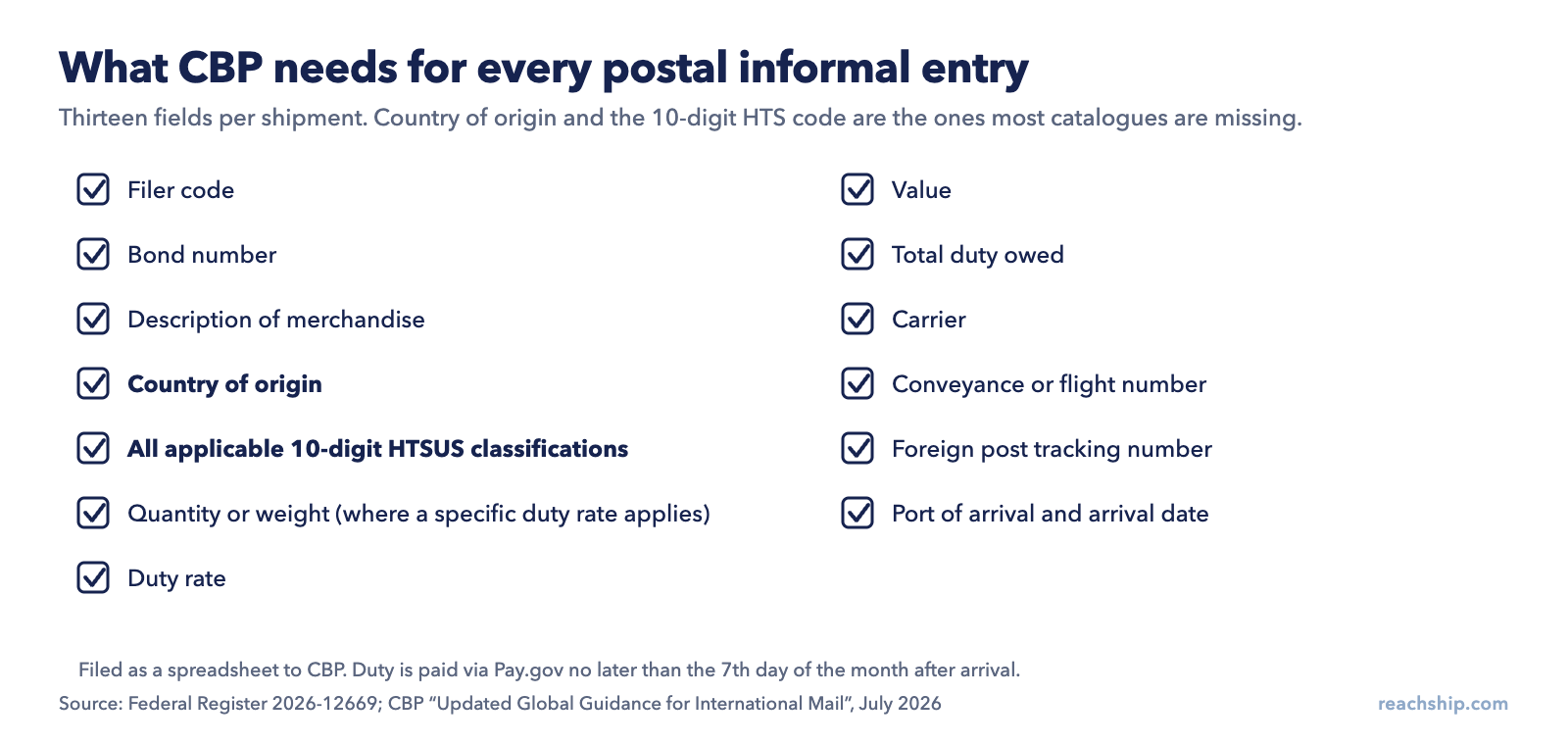
That last point deserves emphasis. Delivered Duty Unpaid is effectively broken for the postal channel. There is no longer a mechanism for the carrier to collect from the recipient at the door.
The October 22, 2026 exclusion deadline
Not everything can use the postal informal process. Goods subject to quota, antidumping or countervailing duties, Chapter 98 or 99 provisions, Partner Government Agency regulation (FDA, USDA, CPSC and others), or a free trade agreement preference claim are excluded and must use another entry type.
Compliance with those exclusions is required from October 22, 2026. If you ship PGA-regulated goods — supplements, cosmetics, certain electronics, food, children’s products — by mail, that is a hard cutover roughly six weeks before Christmas.
What this changes about how you sell
Landed cost has to be rebuilt from HS code and origin
There is no flat country rate to apply. Duty is determined by HTSUS classification and country of origin, with trade remedy measures — Section 232, Section 301 and others — layered on top depending on the commodity and its origin. Rates in this area have changed repeatedly during 2026, so the durable approach is to model landed cost per SKU from classification and origin, and to re-check current rates against CBP and USTR before repricing.
If your pricing model still assumes a flat percentage by destination country, it is producing the wrong number.
DDP is now the default, not an upgrade
Delivered Duty Paid used to be a premium option offered to improve customer experience. It is now close to mandatory for US-inbound ecommerce.
The alternative is a customer who buys a $35 item and receives a duty bill, plus a brokerage fee that can approach the value of the goods. On the postal side, DDU no longer functions at all, because CBP does not collect at delivery.
The upside: the prepaid ceiling in the postal channel is $2,500, considerably higher than the old $800 de minimis threshold. For sellers with higher average order values, the new process is actually more accommodating — once you are set up for it.
You need a broker, a bond and a filing routine
This is the structural change most sellers underestimate. Businesses that used postal channels specifically to avoid customs brokerage now need a broker relationship, a customs bond, a filer code, and a monthly Pay.gov payment cycle.
For many small sellers, brokerage is now a larger new unit cost than the duty itself. Budget it per shipment or per manifest before you set prices, not after the first invoice.
HS codes stop being optional
CBP requires all applicable 10-digit HTSUS classifications. Generic descriptions — “gift,” “sample,” “apparel,” “accessories” — will not clear.
Two jobs follow from this, and both belong to your product data rather than your shipping team:
- Classify your catalogue to 10 digits, per SKU, and store it as a product attribute.
- Lock country of origin per SKU. Origin now drives which trade remedy tariffs apply, so an incorrect origin is a direct duty error with penalty exposure attached.
This is manifest-grade data that most direct-to-consumer stacks do not produce natively. It needs to come out of your product information system and flow into the shipment record automatically — keying it by hand at 200 orders a day is not a plan.
If you ship into the EU, something similar happened
US and other non-EU sellers shipping into Europe faced a parallel change on July 1, 2026, when the EU abolished the €150 customs duty relief for low-value consignments.
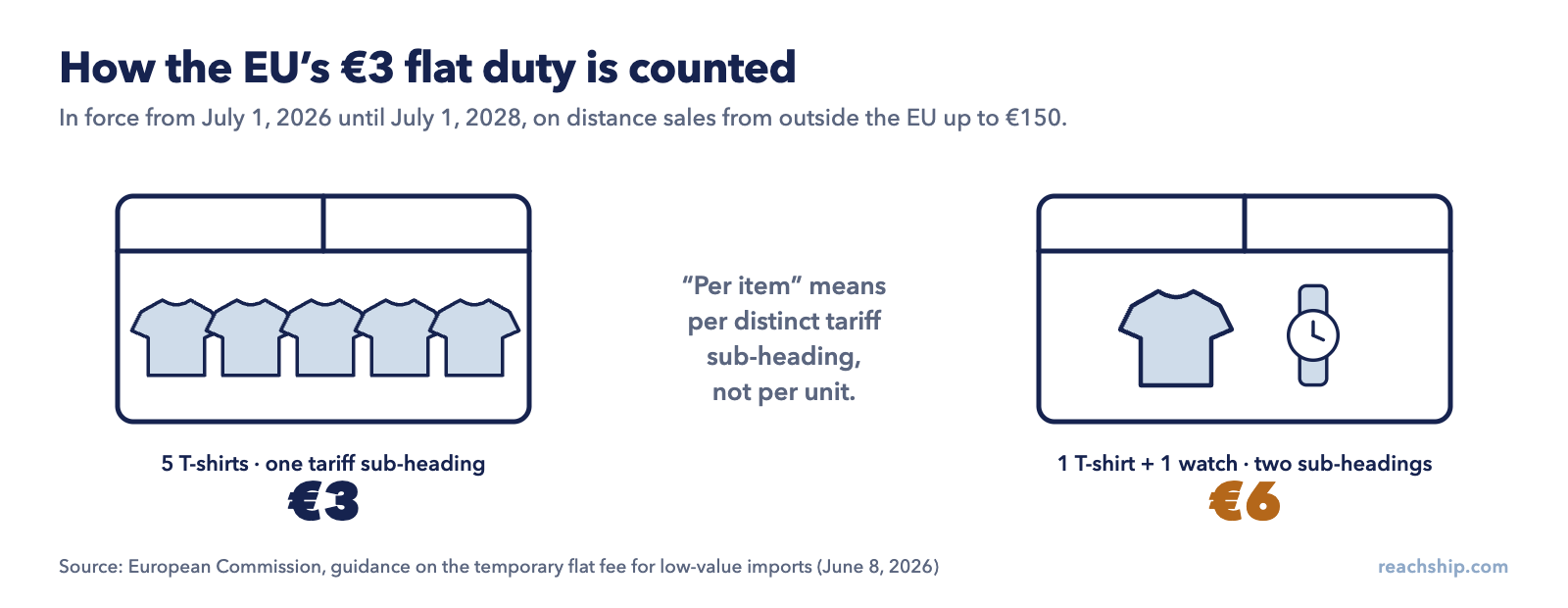
A temporary flat customs duty of €3 per item now applies to low-value consignments in distance sales from outside the EU, running until July 1, 2028, when permanent tariff treatment arrives alongside the EU customs data hub.
The critical wrinkle: “per item” means per distinct tariff sub-heading, not per unit. Five T-shirts in one parcel attract a single €3 charge. One T-shirt plus one watch attracts €6, because they classify differently. Mixed-category parcels are penalised, and consolidating unlike products into one shipment now multiplies the fee.
IOSS and import VAT rules themselves are unchanged. What changed is that duty now applies underneath them, and the declarant — the seller, the IOSS holder or a representative — pays it.
The UK has announced that it will remove its own £135 relief, following a consultation that ran from December 2025 to March 2026, with implementation “by October 2028 at the latest.” The £135 relief is still in force today. Canada’s CUSMA thresholds and Australia’s AUD $1,000 low value threshold are unchanged.
A practical checklist
- Classify your catalogue to 10 digits. Start with the SKUs representing 80% of your cross-border volume. Store HS code and country of origin as product attributes, not spreadsheet notes.
- Appoint a licensed customs broker if you ship by post and do not already have one. Ask specifically about the postal informal entry process and the monthly filing cycle.
- Obtain a customs bond. Continuous is usually cheaper than single-transaction above modest volumes.
- Switch cross-border checkouts to DDP and show landed cost — duty and tax included — before the customer pays.
- Audit for PGA-regulated goods before October 22, 2026. If any of your catalogue is FDA, USDA or CPSC regulated and ships by mail, you need a different entry path.
- Re-check current duty rates before each repricing cycle. This area moved several times in 2026; anything you modelled in the spring may be out of date.
- Rationalise EU parcel contents. Where practical, ship like items together rather than mixing tariff categories in one consignment.
This article is general information, not legal or customs advice. Classification, valuation and entry decisions carry real liability — confirm your specific situation with a licensed customs broker or trade counsel.
Where your shipping platform fits
Most of the burden above is data and compliance, not label printing. But the shipping layer is where the data has to arrive: commercial invoices, customs declarations and electronic advance data all draw from the same fields.
A shipping platform that carries HS code, country of origin, declared value and customs description through from the product record to the carrier’s international manifest removes a whole category of manual error. ReachShip’s multi-carrier shipping platform generates international documentation alongside labels for supported carriers, across WooCommerce, Shopify, Wix and Magento 2.
If you are rebuilding cross-border operations this quarter, our guide to reducing failed deliveries and RTO covers the downstream costs of incomplete shipment data, and address validation addresses the other half of the international delivery failure problem.
Frequently asked questions
Is the $800 de minimis exemption coming back?
There is no indication that it is. The suspension now rests on standing statutory authority rather than emergency powers, it was upheld by the Court of International Trade in August 2026, and Congress separately legislated repeal effective July 1, 2027.
Does this apply to gifts and personal shipments?
The statutory repeal in the 2025 legislation is directed at commercial de minimis, and the separate bona fide gift and personal exemptions sit under different provisions. Treatment of genuinely personal shipments is a question for a customs broker — do not assume a commercial parcel qualifies because it is small.
Can I still use the postal channel at all?
Yes, for shipments valued at $2,500 or less that are not on the excluded list. It requires a bond, entry rights or a licensed broker, complete 10-digit classification data, and monthly duty payment through Pay.gov.
What happens if I get the country of origin wrong?
Origin determines which trade remedy tariffs apply, so an error is a duty underpayment rather than a paperwork slip. The 2025 legislation added civil penalties of $5,000 for a first violation and $10,000 for each subsequent one specifically for misuse of the low-value exemption.
Does the EU €3 fee apply on top of VAT?
Yes. It is a customs duty and applies regardless of which VAT scheme you use — IOSS, the special arrangements, or standard import VAT. The declarant pays it.
Sources
- CBP interim final rule: indefinite suspension of de minimis for mail shipments and new postal informal entry process (FR 2026-12669)
- CBP interim final rule: indefinite suspension of de minimis for all modes other than the international postal network (FR 2026-12670)
- Executive Order 14388: Continuing the Suspension of Duty-Free De Minimis Treatment for All Countries
- Executive Order 14324: Suspending Duty-Free De Minimis Treatment for All Countries
- European Commission: removal of the €150 customs duty exemption threshold
- European Commission: guidance and legal text on the temporary flat fee for low-value imports
- GOV.UK: Reforming the customs treatment of low value imports into the UK
- CBSA: low-value shipment thresholds

No Comments