


FedEx Moves 2,533 ZIP Codes to Remote on January 4: What It Costs You
On January 4, 2027, a FedEx Home Delivery parcel to a particular address in rural Missouri will cost $8.95 more than the identical parcel to the identical address on January 3. The box has not changed. The weight has not changed. The zone has not changed. FedEx has simply moved that ZIP code from one surcharge tier to the next one up.
It has done this to 2,533 ZIP codes.
This is not the 5.9% general rate increase. It is a quiet republication of the Delivery Area Surcharge ZIP code list, and because it is a classification change rather than a price change, it does not appear in any percentage FedEx publishes. For a store with rural customers, it can cost more than the rate increase does.
Quick answer: On January 4, 2027, FedEx replaces its Delivery Area Surcharge ZIP code list. Comparing the two published workbooks, 2,533 ZIP codes move from the Extended tier to the Remote tier, 240 move from standard to Extended, and 46 are surcharged for the first time. A reclassified residential package goes from $8.80 to $17.75, up $8.95; a commercial package goes from $5.55 to $17.75, up $12.20. Export twelve months of destination ZIP codes, match them against both FedEx lists, and you will know your exposure before you set 2027 shipping rules.
What FedEx actually published
FedEx lists its 2027 rate changes on a single page. Under the January 4 heading, one line notes changes to the Delivery Area Surcharge and Pickup Area Surcharge ZIP code lists, followed by links to the new PDF and spreadsheet.
Both lists are public: the one in force today, effective July 20, 2026, and the one that replaces it on January 4, 2027. What FedEx has not published is a summary of the difference. We downloaded both spreadsheets and compared them ZIP code by ZIP code; every count below comes from that comparison.
The tier shift, counted
The Delivery Area Surcharge has three contiguous-US tiers. Think of them as a ladder: standard, Extended, Remote, each costing more than the one below.
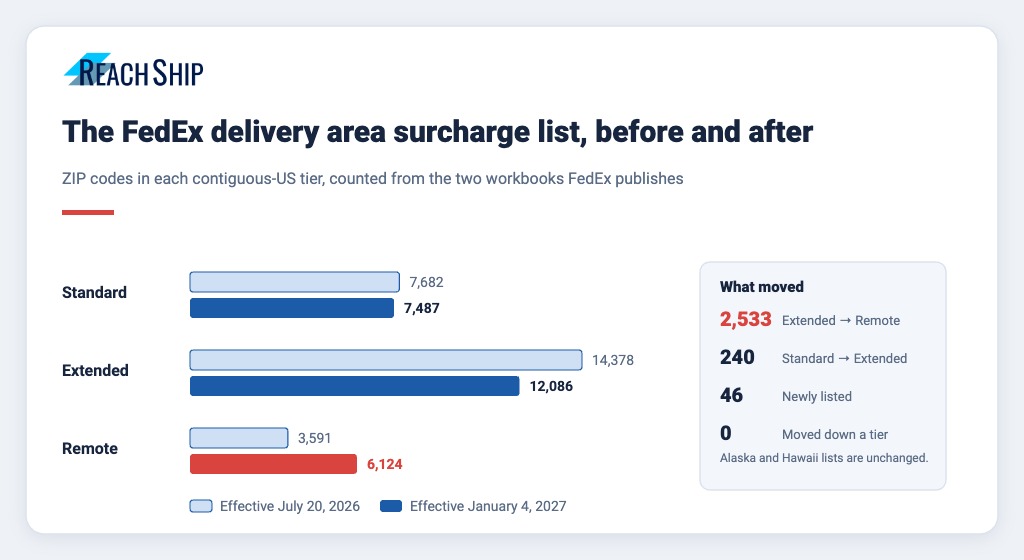
| Tier | Effective July 20, 2026 | Effective January 4, 2027 | Change |
|---|---|---|---|
| Delivery area surcharge (standard) | 7,682 | 7,487 | −195 |
| Extended delivery area | 14,378 | 12,086 | −2,292 |
| Remote area | 3,591 | 6,124 | +2,533 |
| All contiguous US | 25,651 | 25,697 | +46 |
Net totals hide the real movement, because the Extended tier gains ZIP codes from the standard tier at the same time as it loses them to Remote. Tracked individually, 2,533 ZIP codes move from Extended to Remote, 240 move from standard to Extended, and 46 appear on the list for the first time. No ZIP code moves down a tier, and none is removed. The Alaska list (219 ZIP codes) and the Hawaii list (69) are identical in both documents.
The Remote tier grows by 70.5%. Put the other way round, 17.6% of every ZIP code currently sitting in the Extended tier is about to become Remote.
What the move costs per package
The Delivery Area Surcharge is charged per package, on top of the transportation rate and, for a home delivery, on top of the separate residential delivery charge. It is applied after your discount and before fuel. FedEx publishes the amounts in its annual surcharge document, and the 2027 figures are already out.
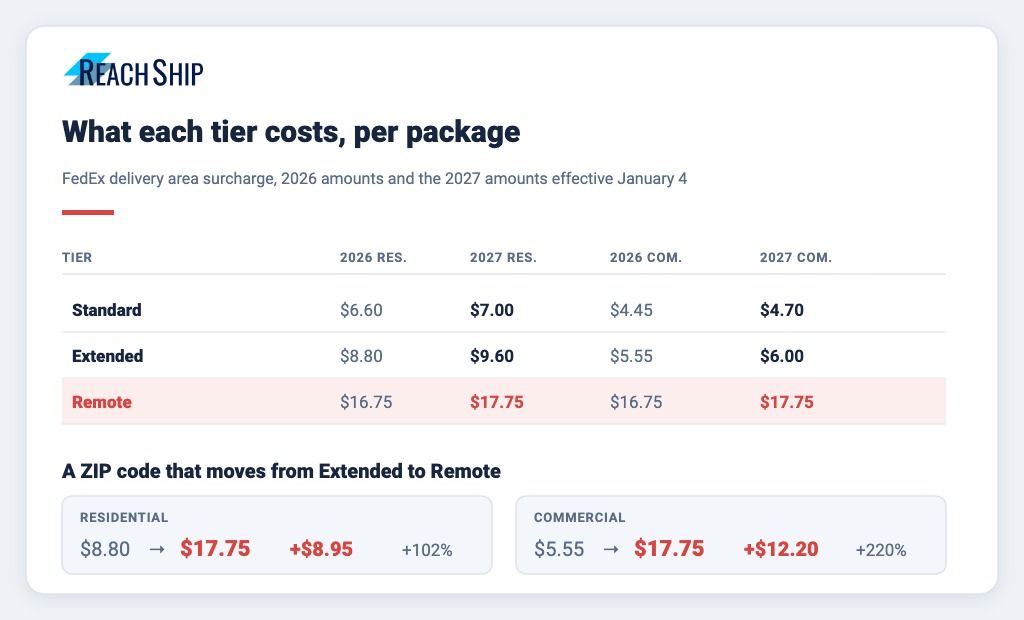
So the arithmetic for a ZIP code moving from Extended to Remote is this. A residential package goes from $8.80 to $17.75 — up $8.95, or 102%. A commercial package goes from $5.55 to $17.75 — up $12.20, or 220%. The Remote tier charges one flat amount either way, which is why commercial shippers take the bigger hit.
A ZIP code moving from standard to Extended goes from $6.60 to $9.60 residential. A newly listed ZIP code goes from nothing to $7.00. And every ZIP code that stays exactly where it is still costs $0.40 to $1.00 more per package, because all three tier amounts rise on the same day.
Three other January dates sit alongside this one. The FedEx residential delivery charge on Ground and Home Delivery rises from $6.45 to $6.90 on January 4, and address correction from $25.50 to $27.00. On January 18, FedEx adds a $25 paper document fee and a $5 paper air waybill fee. On February 1, it reclassifies the zone for a set of origin-destination ZIP code pairs, which is a separate change again. Our January 2027 rate calendar has the full sequence of dates, including where USPS steps back down.
A worked example, with the assumptions stated
None of the above tells you what it costs you. That depends entirely on where your parcels go. Here is a store-sized illustration with every assumption written down, so you can drop your own numbers in.
Assumptions. 24,000 FedEx Home Delivery parcels a year, all residential. Destination mix: 88% to ZIP codes with no delivery area surcharge, 7% standard tier, 4% Extended, 1% already Remote. Of the Extended parcels, 18% go to ZIP codes that move on January 4 — that is the share of Extended ZIP codes that move, used as a stand-in for the share of parcels, which is not the same thing and is the assumption most worth replacing with your own data. List amounts, before fuel and before any negotiated concession.
| Destination tier | Parcels / year | 2026 amount | 2026 cost | 2027 amount | 2027 cost |
|---|---|---|---|---|---|
| Standard | 1,680 | $6.60 | $11,088 | $7.00 | $11,760 |
| Extended (stays) | 785 | $8.80 | $6,908 | $9.60 | $7,536 |
| Extended → Remote | 175 | $8.80 | $1,540 | $17.75 | $3,106 |
| Already Remote | 240 | $16.75 | $4,020 | $17.75 | $4,260 |
| No surcharge | 21,120 | — | $0 | — | $0 |
| Total | 24,000 | $23,556 | $26,662 |
The annual delivery area surcharge bill rises $3,106, or 13.2%. Of that, $1,566 comes from the 175 reclassified parcels — 0.7% of the year’s volume producing half the increase — and the remaining $1,540 from the amount increases on everything else.
Note what the example leaves out. Fuel is assessed on the surcharge as well as the rate, so the real figure is higher. And because the surcharge sits outside your transportation discount, growth here quietly lowers the effective discount you earn across the whole invoice.
How the other carriers price the same rural address
This is where a reclassification becomes a decision rather than a line item. The three national carriers treat rural delivery in structurally different ways, and on January 4 the gap widens.
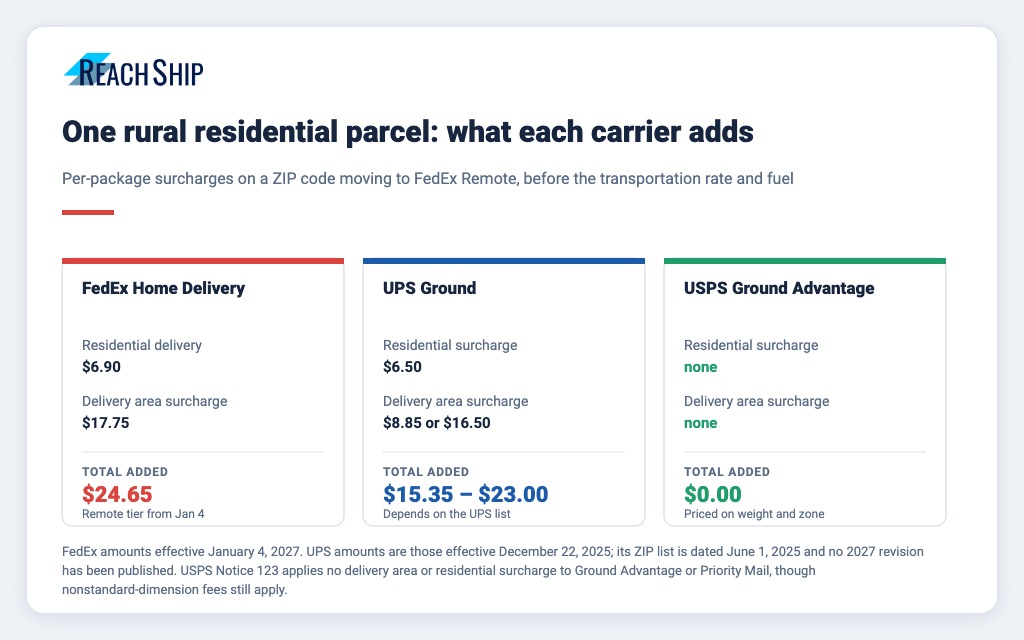
FedEx, from January 4, charges $17.75 on a Remote ZIP code plus the $6.90 residential delivery charge — $24.65 in surcharges before the transportation rate and before fuel.
UPS publishes its own area surcharge ZIP code list, and the workbook on ups.com still carries an effective date of June 1, 2025. UPS has not published a revised list or 2027 amounts as of this writing. On its current published amounts a residential parcel carries a $6.50 residential surcharge plus either $8.85 if the ZIP code sits in the UPS Extended tier or $16.50 if UPS classes it as Remote. Which of the two applies depends on the UPS list, not the FedEx one — so a ZIP code FedEx is about to call Remote may still be Extended at UPS.
USPS does not levy this charge at all. Notice 123, the USPS price list, applies no delivery area, rural, remote or residential surcharge to Priority Mail or USPS Ground Advantage. Those services are priced on weight and zone, with separate fees for nonstandard dimensions. For a light parcel to a far, rural, residential address, that structural difference is often worth more than any discount negotiation would produce. Our comparison of where USPS and UPS each come out ahead covers the weight and zone bands where that holds.
That is the practical conclusion, and a sharper one than “negotiate harder”. Differences this large, on an identifiable subset of destinations, are only capturable if your checkout and your label buying both see every carrier on the same screen. That is what multi-carrier rate comparison is for.
How to find your own exposure in an afternoon
You do not need a consultant for this. You need one export and one spreadsheet.
- Export the last twelve months of shipments with the destination ZIP code, the service used and whether the address was residential or commercial.
- Download both FedEx workbooks from the rate changes page — July 20, 2026 and January 4, 2027 — in XLS rather than PDF.
- Match your ZIP codes against the Remote sheet in each. Anything absent from the 2026 Remote sheet but present in the 2027 one is a reclassified destination.
- Multiply that parcel count by $8.95 for residential and $12.20 for commercial. That is your increase at list, before fuel.
- Read what your FedEx agreement says about the Delivery Area Surcharge. An agreement can cap it, discount it, or waive it on a share of volume; one that does not mention it pays list.
- Check the first invoices after January 4 against the published list, not against the invoice. A package billed Remote whose ZIP code is not on the Remote sheet is a billing error, and it is recoverable.
Five mistakes that make this worse
- Budgeting the 5.9% and stopping there. The general rate increase and the ZIP reclassification are separate events on the same date. A store with rural customers can see the second cost more than the first.
- Assuming the carriers agree on which ZIP codes are remote. They maintain separate lists on separate schedules. From January, FedEx and UPS will disagree about roughly two and a half thousand ZIP codes they agree on today.
- Quoting 2027 shipping at checkout from 2026 assumptions. If you charge flat-rate or free shipping above a threshold, a reclassified rural order silently eats the margin. Rural destinations are where a flat rate is most likely to be underwater.
- Negotiating the transportation discount and ignoring the accessorials. The surcharge sits outside the discount. Accepting the same discount structure against a list that just moved 2,533 ZIP codes up a tier is accepting a rate increase without it being called one.
- Treating it as a FedEx problem rather than a routing problem. The cheapest fix for many of these parcels is not a better FedEx rate. It is a different carrier on that lane, decided automatically at the moment the label is bought.
What to do before January 4
The list is published, dated and not negotiable as a list. What is negotiable is how your agreement treats the surcharge. What is entirely within your control is which carrier the parcel goes out on.
Run the ZIP code match this month, while peak-season volume is fresh and before carrier reviews start in December — you will be deep in peak surcharges until mid-January as it is. If the number is small, budget for it and move on. If it is not small, you have roughly ten weeks to put a surcharge concession in front of your FedEx representative, and to make sure your store can actually quote and buy a competing label for those destinations.
If you want to see what the alternatives cost on your own negotiated rates, you can compare live rates across carriers for a sample of the affected addresses.
Frequently asked questions
When does the new FedEx delivery area surcharge ZIP code list take effect?
January 4, 2027, the same date as the FedEx general rate increase and the 2027 surcharge amounts. The list in force until then is the one effective July 20, 2026. Both documents are published on the FedEx rate changes page, in PDF and spreadsheet form.
How do I find out whether one of my ZIP codes moves to Remote?
Download both workbooks and compare the Remote sheets. A ZIP code that appears on the January 2027 Remote sheet but not the July 2026 one has been reclassified. Doing it against your own shipment export gives an exact number rather than an estimate.
How much more does a reclassified ZIP code cost?
At list, $8.95 more per residential package and $12.20 more per commercial package, before fuel. Residential goes from the $8.80 Extended amount to the $17.75 Remote amount; commercial from $5.55 to the same $17.75. An agreement that caps or discounts the surcharge pays less.
Is this part of the 5.9% general rate increase?
No. The 5.9% is the average increase to standard list transportation rates. This is a change to which ZIP codes fall into which surcharge tier, and it is not reflected in that percentage or in the published surcharge increases either. Both land on January 4, which is why they are easy to confuse.
Can the delivery area surcharge be negotiated?
Yes, and it is one of the terms most often left at list. Agreements can cap the surcharge, apply a percentage discount to it, or waive it on a defined share of packages. A shipper with heavy rural residential volume has a reasonable case for asking, and the reclassification is a concrete reason to raise it now.
Do UPS and USPS charge the same thing?
Not on the same terms. UPS has an equivalent surcharge with its own ZIP code list, last published effective June 1, 2025, and has not announced 2027 amounts. USPS applies no delivery area, remote or residential surcharge at all to Priority Mail or USPS Ground Advantage, pricing those on weight and zone instead. The carriers you can compare side by side matters most precisely on these destinations.
Sources
- FedEx, Shipping rate changes, including the Delivery Area Surcharge ZIP code lists effective July 20, 2026 and January 4, 2027.
- FedEx, 2027 changes to FedEx surcharges & fees (PDF), effective January 4, 2027.
- UPS, Revised Rates for Value-Added Services and Other Charges (PDF), effective December 22, 2025, and the UPS Area Surcharge ZIP Codes workbook, effective June 1, 2025.
- USPS, Notice 123, Price List.
- ZIP-code counts in this article are our own comparison of the two FedEx workbooks named above.

No Comments