


How to Choose the Right Packaging for E-Commerce Shipments
If you’re running an e-commerce business, then choosing the right packaging is crucial. It’s about curating the right experience for your customers and choosing the right packaging to optimize shipping charges as well.
When it comes to packaging for e-commerce, what matters most is delivering a good customer experience. The package’s shape, size, and colour are all factors that affect the experience. At the same time, it can also increase the costs that you may have to incur during your shipping process.
A box that is too large can increase the amount of space you’re paying to transport. A box that is too small may not leave enough room for protection. And packaging that isn’t strong enough can turn a successful order into a costly return.
So, how do you choose the right packaging for e-commerce shipments?
Let’s find out how to choose the right packaging for e-commerce shipments!
Why Does E-Commerce Packaging Matter?
When you’re selling a product, it goes through many stages before it reaches the customer. This involves picking, packing, loading, transportation, sorting, and handling. At the end is the final delivery of the product.
One of the reasons why packaging matters so much is that it needs to ensure that the product is protected from any issues that may occur during the shipping process. Packaging also affects various other factors such as shipping costs, packaging material costs, packing time, packaging waste, and customer experience.
Second, it affects how much you pay to ship the order. Carriers may consider both the actual weight and the dimensions of a package when calculating the billable weight.
But the most important factor is how much packaging affects your customer’s experience. A damaged product, crushed box, or excessive amount of packaging can all create a negative impression of your brand.
And finally, packaging for e-commerce also has a huge environmental impact. How you package your products impacts the environment as well.
What Should You Consider When Choosing Packaging for E-commerce?
Before choosing a box, mailer, or protective material, there are multiple factors be considered. But the most important aspects to be considered are these six factors:
- Product size and shape
- Product weight
- Product fragility
- Shipping distance and handling
- Shipping cost
- Customer and sustainability expectations
Let’s look at each one.
1. Product Size and Shape
First, measure the product. Its length, width, height, and weight need to be measured. Unusual shapes, handles, or any protruding parts, or compressibility are also some factors that need to be considered.
A small, flexible product may work well in a mailer, while a rigid or fragile product will usually need a box.
2. Product Weight
Weight affects both the strength of the packaging you need and the cost of shipping it.
Heavy products generally require stronger boxes, better sealing, and packaging materials that can withstand the additional load.
For businesses selling products across multiple weight categories, it can be useful to create different packaging rules for lightweight, medium-weight, and heavy products.
3. Product Fragility
A T-shirt and a glass vase shouldn’t and cannot be packaged the same way. So what are the things that yo u need to consider during your packaging decision-making?
Ask these questions about your product to determine if it’s fragile or not;
- Can the product break?
- Can it be scratched?
- Can it be crushed?
- Can it leak?
- Can it be damaged by moisture?
- Does it need to remain upright?
- Can the product move freely inside the package?
The more vulnerable the product, the more important it becomes to combine the right outer package with appropriate internal protection.
4. Shipping Distance
A package traveling across town may experience fewer handling stages than one traveling across a country or internationally.
For longer-distance shipments, consider stronger outer packaging and better internal protection, particularly for fragile products.
5. Shipping Cost
Shipping costs can depend on:
- Actual weight
- Package dimensions
- Destination
- Delivery speed
- Carrier
- Service level
- Package type
This makes packaging optimization an important part of shipping cost management.
6. Customer Experience
Packaging is also part of your brand.
A premium product arriving in an oversized box filled with unnecessary plastic can create a very different impression from the same product arriving in a neatly sized, thoughtfully designed package.
The goal isn’t necessarily to make every package luxurious.
It’s to make it appropriate for shipping and the customer. It’s to ensure that a customer receives a package that may make them keen on receiving another one again.
How to Choose the Right Packaging Type for Your Product
There isn’t one universally best type of e-commerce packaging.
Different products call for different solutions. So how do you make a decision?
Let’s take a look at different package types and what products work best for them.
1. Corrugated Boxes

Corrugated boxes are one of the most versatile options for e-commerce shipping.
They work particularly well for:
- Electronics
- Home goods
- Cosmetics
- Multiple-item orders
- Fragile products
- Heavier products
The required box strength depends on the product, weight, stacking requirements, and shipping conditions.
2. Padded Mailers
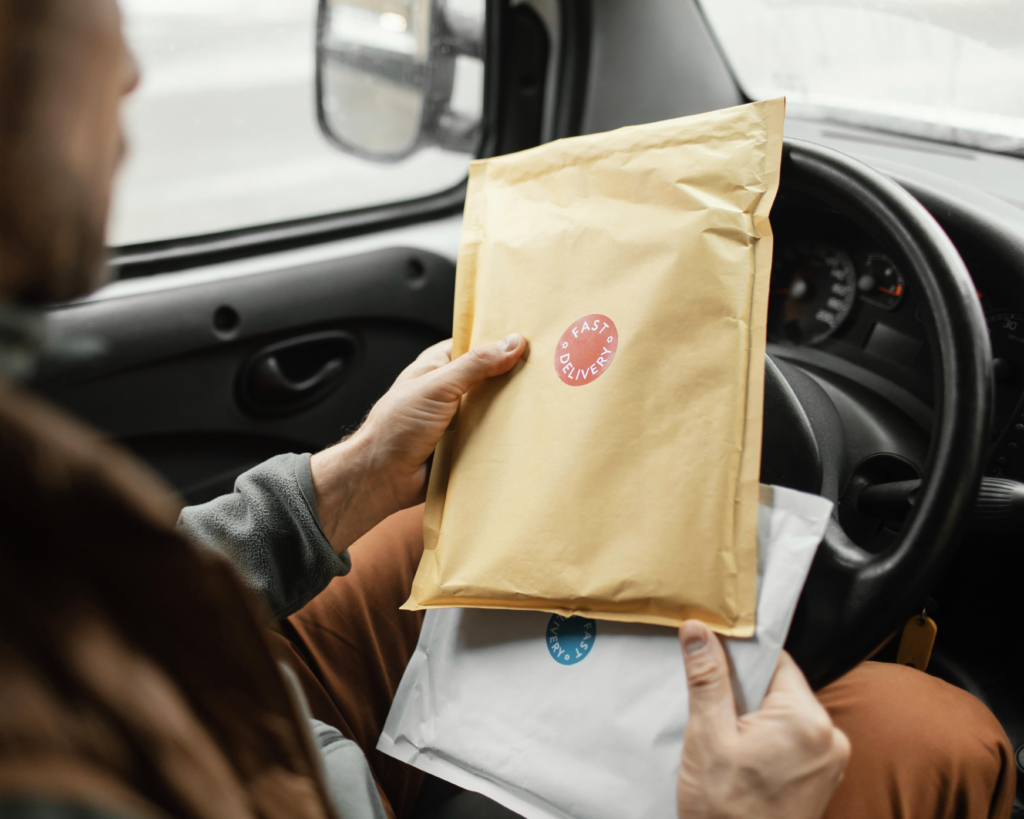
Padded mailers combine an outer flexible layer with internal cushioning.
They can be useful for products that don’t require the structural protection of a box but still need some impact protection.
Examples include:
- Books
- Accessories
- Small electronics
- Certain cosmetics
- Small non-fragile products
3. Poly Mailers

Poly mailers are lightweight and flexible, which makes them useful for products such as apparel and other soft goods.
Their biggest advantage is that they take up little space.
However, they’re not suitable for products that can easily break, bend, or become damaged through compression.
4. Rigid Mailers
Rigid mailers are particularly useful for flat products that need protection from bending.
They’re commonly suitable for:
- Documents
- Prints
- Photographs
- Certificates
- Books
- Small flat products
5. Custom Boxes and Inserts
For unusual, fragile, premium, or high-value products, custom packaging can provide a better fit.
Custom inserts can prevent products from moving around inside the box while reducing the need for excessive void fill.
How to Choose the Right Box Size for E-commerce Shipping
One of the most common packaging mistakes is choosing a box that is much larger than the product.
Just because the product fits inside doesn’t mean the box is the right size.
The ideal package should leave enough room for necessary protection without creating excessive empty space.
Think about the packaging layers
A typical shipment may look like:
Product-Protective material – Inner packaging- Outer box
When selecting the box, you must account for all of these layers.
For example, if your product measures 20 × 15 × 8 cm, don’t automatically select a box with those exact internal dimensions if the product requires cushioning.
Instead, determine how much protective space is genuinely required and choose the smallest practical package that accommodates it.
What Is Dimensional Weight?
Dimensional weight, also called DIM weight or volumetric weight, is a way carriers account for the amount of space a package occupies.
The basic concept is:
Length × Width × Height ÷ Carrier Divisor = Dimensional Weight
The exact divisor and calculation method depend on the carrier and service. Dimensional weight is the primary method by which carriers come up with shipping prices. It reflects the space a package occupies, which is compared with its actual weight.
This is particularly important for products that are large but lightweight.
Imagine shipping a lightweight pillow in a huge box.
The product may weigh only 1 kg, but the box could occupy enough space to result in a much higher dimensional weight.
That’s why right-sizing your packaging can help control shipping costs.
Why Right-Sizing Packaging Matters
Right-sizing means selecting packaging that is appropriately sized for the product rather than defaulting to oversized boxes.
It can help you:
- Reduce empty space
- Reduce packaging material
- Reduce void fill
- Reduce package volume
- Improve warehouse storage
- Potentially reduce dimensional-weight charges
- Improve the unboxing experience
There is also a sustainability argument for right-sizing.
How Much Cushioning Does Your Product Need?
Cushioning protects products from impacts and helps absorb shocks during transportation. Cushioning, as the word suggests, is protection against damage. It ensures that there is enough protection to prevent damage to your product during the shipping process. There are several ways you can cushion your packages.
Common cushioning materials include:
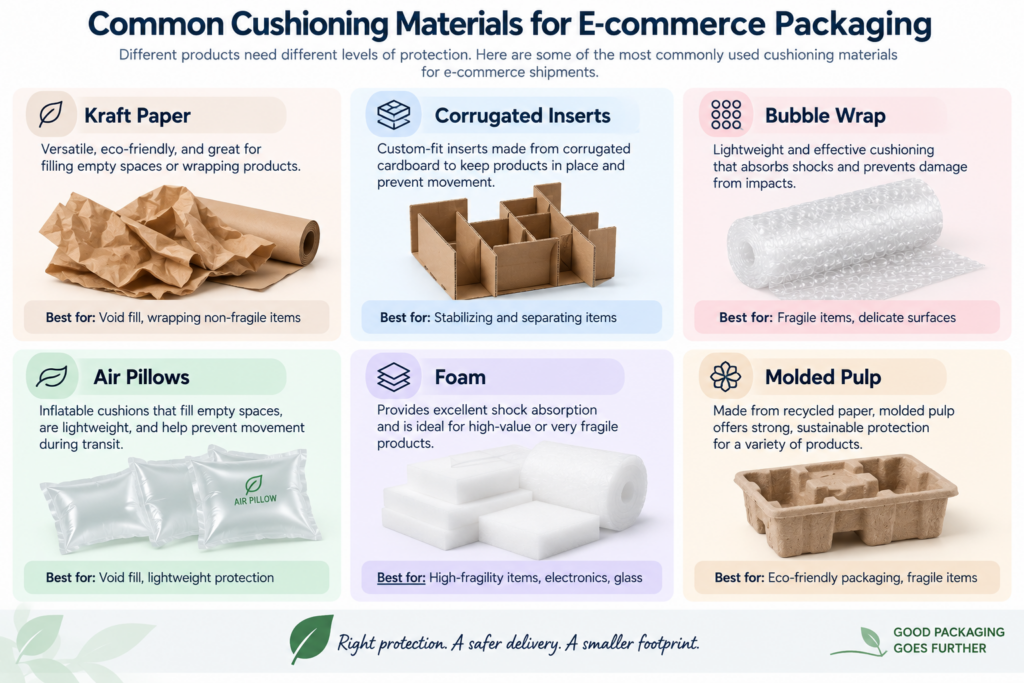
- Kraft paper
- Corrugated inserts
- Bubble wrap
- Air pillows
- Foam
- Molded pulp
The amount you need depends on the product as well.
- For non-fragile products: You may need little or no additional cushioning.
- For moderately fragile products: Use enough cushioning to prevent the product from moving and protect vulnerable surfaces.
- For highly fragile products: Consider using
- Individual wrapping
- Custom inserts
- Strong corrugated boxes
- Additional void fill
- Double boxing where appropriate
How to Choose Packaging for Fragile Products
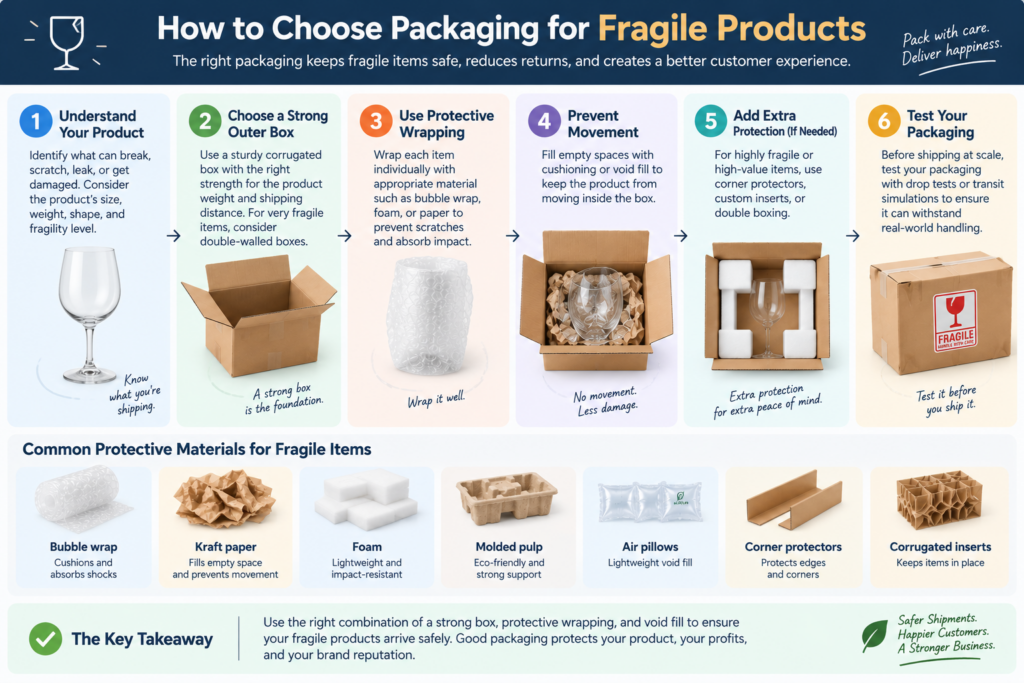
Fragile products need more than simply adding bubble wrap and cushioning. When you’re trying to choose how to package your fragile products, it’s important to first begin with product understanding.
Identify the areas most likely to break or become damaged.
Then consider:
1. How to prevent movement?
A product bouncing around inside a box can experience repeated impacts.
2. How to protect vulnerable surfaces?
Glass, screens, corners, edges, and polished surfaces may need additional protection.
3. Use an appropriately strong outer box
Internal cushioning cannot compensate for an outer box that collapses easily.
4. Test the complete package
Don’t test the product and packaging separately.
Test the finished shipment. See how well the packaging protects your product.
This is important because packaging performance depends on how all components work together.
And the cost of getting it wrong can be high.
How E-Commerce Packaging and Shipping Costs Can Affect Conversions
Packaging decisions can even have an indirect effect on sales. When you choose your packaging, you’re deciding what works best for the customers and your margins. You’re choosing how much customers will inadvertently pay as well.
So if your packaging costs more than your business can afford, then customers will end up paying extra, and that’s not something they’d like. Baymard Institute found that 39% of shoppers abandoned checkout because extra costs such as shipping, taxes, and fees were too high.
This doesn’t mean packaging alone causes cart abandonment. But it does demonstrate why controlling shipping costs matters. This is one reason businesses should evaluate packaging and shipping together rather than treating them as completely separate processes.
How to Choose Sustainable E-commerce Packaging
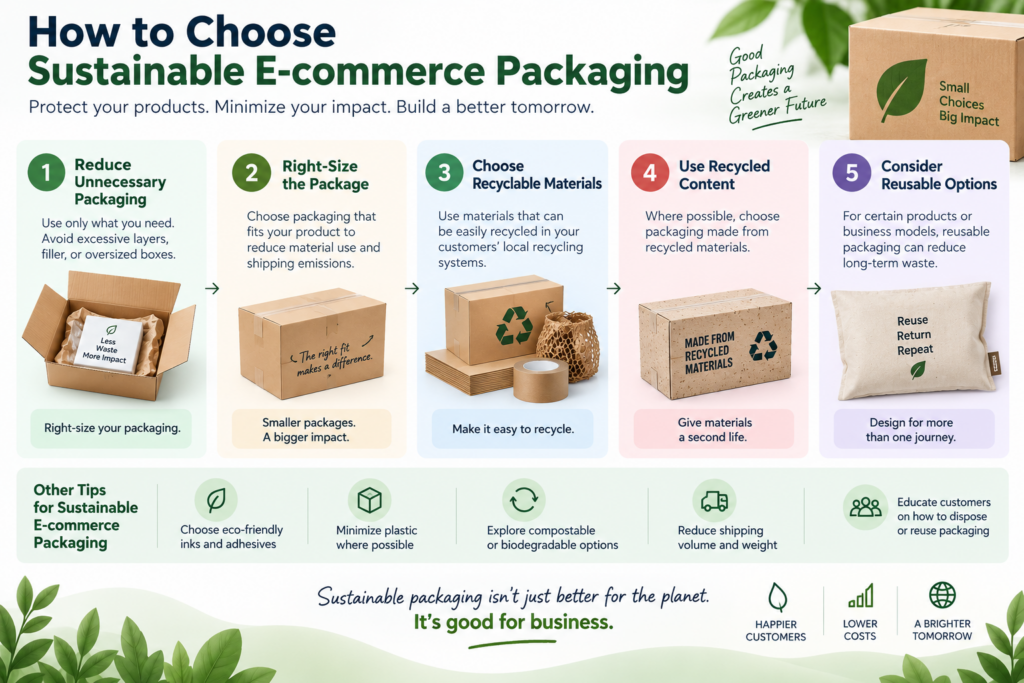
In a world where brand values are becoming increasingly important to showcase, sustainability is one that customers prefer most. 80% of consumers are willing to pay more for sustainably produced goods or packaged items.
This shows the importance of sustainable packaging options. If you, as a brand, promote and believe in sustainability, then sustainable packaging is something that you can offer customers.
If sustainable packaging is not affordable in the initial stages, yet it’s something you want to promote, then perhaps you can show it through practice;
Reduce
Don’t use packaging you don’t need. This way, you can avoid paying for packaging that your business doesn’t need. For this, you have to be explicitly aware of the different dimensions and sizes of packaging you need for your products.
Right-size
Reduce unnecessary package volume. You need to buy the right-size packaging to avoid unnecessary package volume. This ensures that you’re not paying more than necessary.
Reuse
Where practical, design packaging that can be reused. This way you give your customers something to remember your brand as well!
Recycle
Use materials that can be appropriately recycled within the relevant waste system.
Replace
Where a better material genuinely improves the environmental profile without compromising protection, consider switching.
The key to sustainable packaging for e-commerce is balance, truly. Where underpackaging can create damage, overpackaging increases shipping volume. Either way, finding a balance to ensure a smooth shipping process is what you can do.
Should You Use Branded E-commerce Packaging?
Branded packaging is basically curating a customer experience through customized boxes and shipping materials. Instead of using standard boxes, you may have a customized box with your brand’s logo, which makes your brand more memorable for the customer as well.
41% of customers say that branded packaging encourages them to place future orders.
For creating branded packaging, you might be using items such as;
- Branded boxes
- Printed mailers
- Custom tape
- Thank-you cards
- Product inserts
- Custom tissue paper
- Reusable packaging
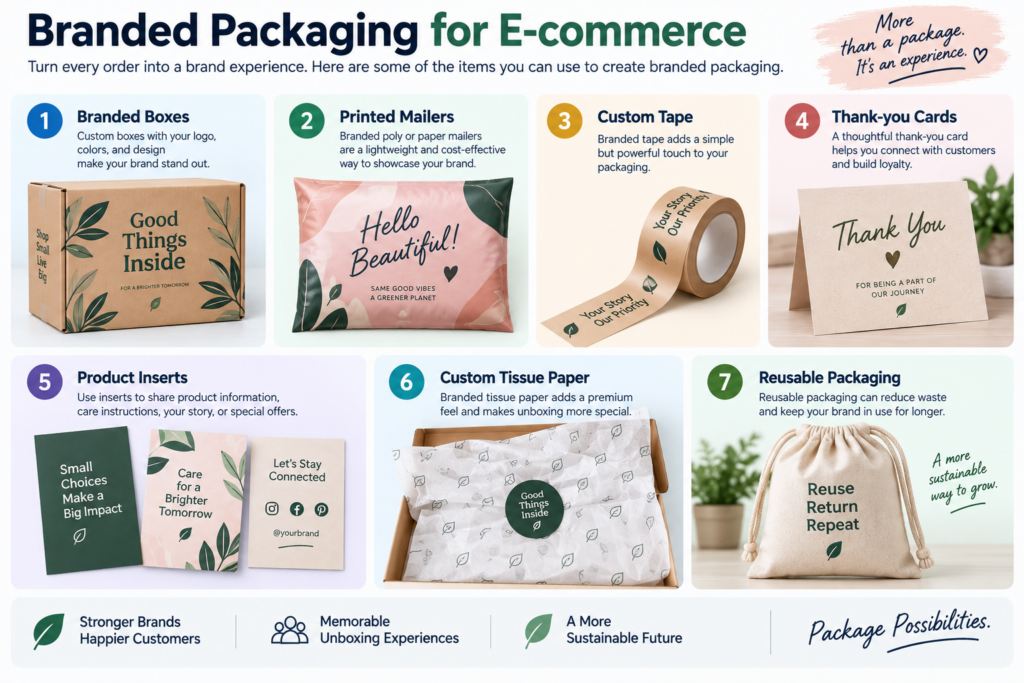
While branded packaging is important and something you should try to incorporate into your business, it’s always good to have a balance too. If you’re going the branded packaging route, ensure that the shipping efficiency is not compromised in any way.
A beautifully printed oversized box may cost considerably more to ship than a simple, appropriately sized package. But it may also create the experience that would ensure that customers return to buy from your store.
How Many Packaging Sizes Should an E-commerce Business Have?
Using one box for everything might seem like the convenient way to go. But at the same time, it can create unnecessary costs.
If you sell products in multiple sizes, consider creating a small range of packaging sizes.
For example:
- Small mailer
- Small box
- Medium box
- Large box
- Heavy-duty box
You can create a simple SKU-to-packaging matrix, something like this;
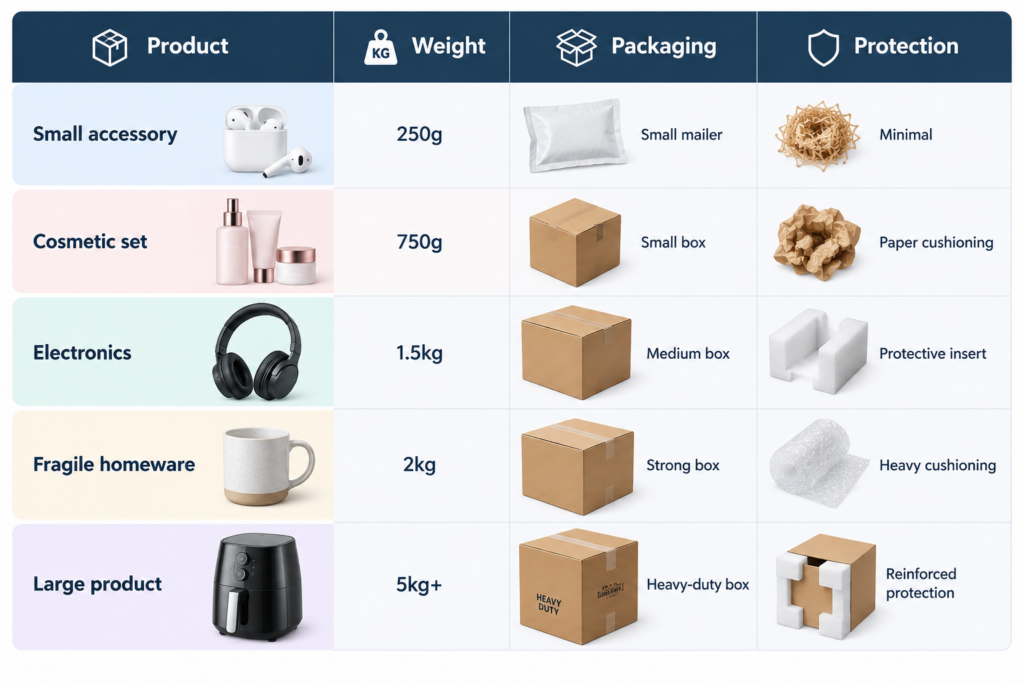
Then you can assign the products to the appropriate packaging type. This way, you can ensure that the products are allocated to the right packaging, which would help you save costs as well. The e-commerce packaging that works best is what creates ease for your business.
Common E-commerce Packaging Mistakes to Avoid
There are many ways you can fumble your packaging for your store. What you need to do is remain vigilant and ensure that you’re choosing the best packaging according to the factors that matter for your store. There are a few mistakes that many e-commerce store owners commonly tend to make.
You should try your best to avoid them;
1. Using one box size for everything
Different products need different packaging. If you use the same box for each product, then you’ll end up overpaying for shipping. This might reduce your overall profits. It could also lead you to increase the cost of your products, which would make customers shy away from buying them, in case there’s a better, more affordable option available for them.
2. Choosing packaging based only on price
Choosing a cheaper box to cut costs is not the best strategy. It can result in a greater number of damages during the shipping process. This would only increase the number of returns your store receives.
3. Under-packaging fragile products
Sometimes you may under-package your fragile products, thinking nothing would happen. But under-packaging leaves your products unprotected and exposed. This could cost you during your shipping process, where the product may get damaged somewhere. In an effort to save on packaging costs, you would be paying more in replacing a damaged product!
4. Ignoring return shipments
If products are commonly returned, consider whether the original packaging can be reused.
But it also begs the question: why are your products being returned so frequently? That may be a problem that you need to solve because of the frequency of return shipments.
8. Never test your packaging
Packaging should be tested before it becomes your standard fulfillment process. This means that it should be tested against different extreme conditions, rough handling, among other verification processes.
Conclusion
When you’re trying to decide how to choose the best packaging for your e-commerce store, what you need to focus on is finding the right balance. No one box will fit all the checks that you want, but if it fits the majority of what you need, then it’s probably the right one for you.
But most importantly, as important as the aesthetic of the box can be, what’s more important is how the packaging protects the product without unnecessarily increasing its size, weight, cost, or environmental impact. These are non-negotiable factors that you must take into consideration in your journey.
If you’re running a WooCommerce store, you can also explore ReachShip’s WooCommerce packaging setup guide and its weight-based packaging guide to see how custom box sizes, weight limits, and packing methods can be configured.
The goal isn’t necessarily to use the cheapest packaging or the most sustainable packaging. It’s about finding and choosing the right packaging that is best for your business. The packaging that gets your product to the customer safely, efficiently, and affordably is what you’re in search of.
Frequently Asked Questions
1. What is the best packaging for e-commerce shipping?
There is no single best packaging option for every e-commerce product. It depends on the product type, weight, and its dimensions.
2. How do I choose the right box size for shipping?
First of all, you should measure the product and account for the protective material it requires. Choose the smallest practical box that provides adequate protection without compressing or damaging the product.
3. What is right-sizing in e-commerce packaging?
Right-sizing means selecting packaging that closely matches the product’s dimensions while leaving enough room for necessary protection. It reduces unnecessary empty space, material usage, and potentially dimensional-weight charges.
4. What packaging is best for fragile products?
Fragile products generally require a strong outer box combined with appropriate internal cushioning or inserts. The exact solution depends on the product’s shape, fragility, weight, and shipping environment.
5. How many packaging sizes should an e-commerce business have?
There is no specific number of packaging. However, to make things easier for your business, having several packaging tiers based on your product dimensions and order patterns would work better than using one oversized package for every shipment.
Further Reading

No Comments